 ultimate-guide
Can Flapless Implants Work for Full Mouth Restoration?
Table of Contents
- What Flapless Implant Surgery Is and How It Works
- The Benefits of Flapless Implant Surgery for Full-Arch Cases
- Who Qualifies for Full-Mouth Restoration With Flapless Implants
- Full Mouth Dental Implant Recovery Time: What to Expect
- Flapless vs. Traditional Flapped Surgery: A Side-by-Side Comparison
- Success Rates and Long-Term Maintenance for Flapless Implants
- Frequently Asked Questions
Last Updated: September 15, 2026
What Flapless Implant Surgery Is and How It Works
Flapless implant surgery is a technique for placing dental implants through a small opening in the gum tissue without lifting a full-thickness flap. At Kevin Nail DDS, we use this approach. (Source: reduced post-operative morbidity)
The procedure starts with a tissue punch or a small incision at the planned site. The surgeon then drills and places the implant directly through that opening. No sutures are usually needed, and the gum stays largely undisturbed.
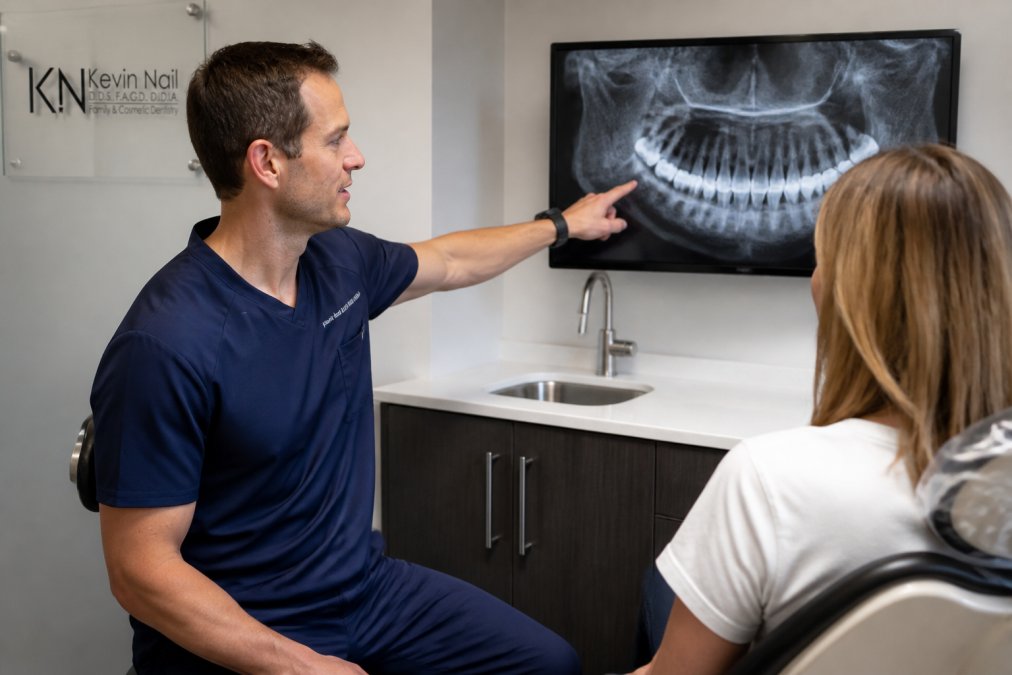
The digital workflow behind flapless placement is what makes the precision possible. A CBCT scan captures the three-dimensional shape of the alveolar ridge, including bone volume and the position of nerves and sinuses. That scan feeds into surgical guide software, which maps the exact angle and depth for each implant. The surgeon then places a surgical guide over the gum during the procedure, so the drill follows the pre-planned path rather than a freehand estimate.
The Benefits of Flapless Implant Surgery for Full-Arch Cases
The main benefit of flapless implant surgery is reduced post-operative morbidity. Because the gum isn't peeled back, there's less bleeding, less swelling, and less disruption to the blood supply that feeds the bone. But for a full-arch case, the benefit isn't just a smaller wound, it's that the entire restoration is planned and executed as one coordinated digital event rather than a series of freehand surgical decisions.
Why the Full-Arch Case Is Different
A full-mouth restoration involves multiple implant sites across the maxillary and mandibular arches, commonly four to six implants per arch, so eight to twelve total. When you avoid a large flap at every site, the cumulative effect on soft tissue healing is significant. Patients typically report less discomfort and return to normal activity sooner.
There's a second benefit that gets less attention: the soft tissue stays where it was. When a flap is lifted and replaced, the gum can recede or lose its natural contour. Keeping the tissue intact helps preserve the biologic width around each implant, which supports a more natural-looking final restoration, and in full-arch work, where the prosthesis margin sits right at the tissue interface, that contour is what determines whether the final result looks like a denture sitting on the gum or like teeth emerging from it.
The Digital Workflow Is the Real Benefit
What most articles skip is the mechanism that makes flapless full-arch restoration safe in the first place: the digital chain from scan to guide to prosthesis.
- CBCT acquisition. A cone beam CT scan captures the three-dimensional shape of the alveolar ridge, including bone volume, bone density, and the position of the inferior alveolar nerve and maxillary sinuses.
- Intraoral scanning. An intraoral scanner captures the soft tissue surface and the existing dentition or prosthesis, which is merged with the CBCT data in planning software.
- Virtual implant planning. The clinician positions each implant in the software, checking angulation, depth, and the restorative path, the same data the lab will later use to design the final prosthesis.
- Surgical guide fabrication. A CAD/CAM-milled or 3D-printed surgical guide is produced with metal sleeves that control the drill's angle and depth at each site.
- Guided placement. The surgeon seats the guide over the gum and places each implant through the pre-planned path. No flap is lifted because the planning has already replaced the need to see the bone directly.
That chain is what separates a predictable flapless full-arch case from one that's flapless in name only. The guide is only as good as the scan and the plan behind it, and the final prosthesis is only as good as the implant positions the guide produced.
Benefits That Compound Across the Arch
- Shorter chair time per arch in many guided cases, because the surgical sequence is predetermined rather than decided in the moment.
- Less bleeding and swelling across multiple sites, which matters more when eight to twelve osteotomies are involved than when one is.
- Preserved papilla and ridge contour, which supports a more natural emergence profile for the final prosthesis.
- A restorative-driven plan from day one, because the same digital data drives both the surgery and the lab work.
Who Qualifies for Full-Mouth Restoration With Flapless Implants
Not everyone is a candidate, and the deciding factor is usually bone, but the specific disqualifiers are more granular than most guides admit. A flapless full-arch case only works when the surgeon can trust the imaging and the guide to replace direct visualization of the ridge. That trust has anatomical limits.
Bone Volume and Density Requirements
Flapless placement works best when the alveolar ridge has enough bone volume and density to hold the implant without grafting. As a general rule, a site needs roughly 1 mm of bone beyond the implant surface on all sides, and enough vertical height to place an implant of adequate length without approaching the inferior alveolar nerve or the maxillary sinus floor (pubmed.ncbi.nlm.nih.gov).
Density matters as much as volume. The posterior maxilla is often soft (low-density trabecular bone), which can make primary stability harder to achieve through a small opening. The anterior mandible is typically dense, which is one reason flapless full-arch cases in the lower jaw are often more predictable than in the upper.
When Bone Grafting for Dental Implants Is Needed First
Bone grafting for dental implants becomes necessary when the jaw can't support an implant on its own. This is common after years of missing teeth, since alveolar bone loss continues without the stimulation of a tooth root.
When grafting is required, the case often shifts to a staged approach: graft first, heal, then place implants. Some grafting can still be done with limited flap elevation, but the fully flapless path is usually off the table for that site until the graft matures. A ridge that has resorbed into a knife-edge shape, or that has a severe undercut, is generally not a flapless candidate because the guide can't compensate for anatomy the surgeon can't see and can't feel.
Soft Tissue Conditions That Disqualify a Flapless Approach
This is the part most guides skip. The gum isn't just a covering, it's the structure the guide seats against, and it's the tissue that has to heal around the implant. Specific soft tissue problems that push a case toward a flapped approach include: (Source: digital workflow in dentistry)
Medical and Behavioral Contraindications
Anatomical Limits That Rule Out Flapless Placement
Full Mouth Dental Implant Recovery Time: What to Expect
| Phase | What Happens | Typical Timeline |
|---|---|---|
| Initial healing | Gum tissue closes, swelling and soreness settle | First 1-2 weeks |
| Osseointegration | Implant fuses with bone | Several months |
| Healing abutment and impressions | Soft tissue shaped, final restoration planned | After osseointegration |
| Prosthetic rehabilitation | Implant-supported denture or fixed arch delivered | Final stage |
Flapless vs. Traditional Flapped Surgery: A Side-by-Side Comparison
| Factor | Flapless | Traditional Flapped |
|---|---|---|
| Gum incision | Small punch or mini-incision | Full-thickness flap lifted |
| Sutures | Rarely needed | Usually required |
| Swelling and bleeding | Generally less | Generally more |
| Direct bone visibility | None; relies on CBCT and guide | Direct visualization |
| Best suited for | Adequate bone, guided planning | Complex anatomy, grafting, revision cases |
Success Rates and Long-Term Maintenance for Flapless Implants
What long-term care actually looks like:
Frequently Asked Questions
What are the options for a full mouth dental implant replacement?
Full-arch restoration typically uses implant-supported bridges or overdentures anchored by four to eight implants per arch. Some patients qualify for flapless placement guided by a CBCT scan and surgical guide, while others need a traditional flapped approach, especially when bone grafting is required. Your dentist will determine the right option after reviewing your imaging and health history.
How long does it take to fully recover from a full mouth dental implant surgery?
Full mouth dental implant recovery time varies by case. Most swelling and soreness settle within one to two weeks, and many patients return to normal activity within a few days. Flapless techniques can reduce post-operative morbidity because there is no full-thickness flap to heal. Complete osseointegration, when implants fuse with bone, usually takes three to six months before final teeth are placed.
Is flapless implant surgery safer than traditional methods?
Flapless surgery is generally considered minimally invasive because it avoids raising a full-thickness flap, which can mean less bleeding, swelling, and discomfort. However, it requires adequate bone volume and precise planning with a CBCT scan and surgical guide. It is not automatically safer for every patient; candidacy depends on your anatomy and overall health, so a consultation is essential.
Can I get dentures that don't cover the roof of my mouth?
Yes. Implant-supported dentures and full-arch bridges are designed to anchor to implants rather than rest on the palate, so they do not cover the roof of your mouth. This improves comfort, taste, and speech compared with traditional removable dentures. The number and position of implants needed will depend on your bone volume and the prosthetic design your dentist recommends.