 blog
blog
Affordable Dental Implants in Houston: Cost & Financing
Table of Contents
- Understanding the Real Cost of Affordable Dental Implants in Houston
- Dental Implant Financing Options and Payment Plans
- The Dental Implant Procedure and Recovery Time Explained
- Benefits of Flapless Implant Surgery for Missing Teeth Replacement
- Hidden Costs and Fee Transparency in Implant Dentistry
- How to Choose a Reputable Provider for Affordable Dental Implants in Houston
- Frequently Asked Questions
Last Updated: September 16, 2026
Understanding the Real Cost of Affordable Dental Implants in Houston
Most people researching affordable dental implants in Houston start with the same question: what will this actually cost me? The honest answer is that no single price exists, because implant pricing depends on your bone structure, how many teeth you're replacing, and which materials your provider uses. This guide from Kevin Nail DDS breaks down what drives the bill, how financing works, and how to spot a quote that looks cheap but isn't.
What Influences the Total Price of Implant Surgery
The total price of implant surgery is built from four separate line items, and any quote that bundles them into one vague figure deserves scrutiny.
- The implant fixture itself, a titanium post from a specific implant system
- The abutment, the connector between post and crown
- The final restoration, usually a zirconia crown or implant-supported dentures
- Surgical and diagnostic fees, including 3D cone beam imaging and any bone grafting or sinus lift
Dental Implant Financing Options and Payment Plans
Financing turns a large one-time cost into a manageable monthly payment, and most patients use some combination of insurance, third-party medical credit, and in-house plans. The gap most cost guides leave open is the difference between a true medical credit line and a promotional retail card, they behave very differently once the promo window closes.
Common dental implant financing options include:
- Third-party medical credit lines such as CareCredit, Alphaeon Credit, and the LendingClub patient financing program, which are accepted by many dental practices and issue a decision in minutes
- In-house payment arrangements negotiated directly with your dental office, often interest-free over 6-24 months for established patients
- Health savings or flexible spending accounts, which let you pay with pre-tax dollars, but only up to the annual contribution limit you elected during open enrollment
- Credit cards with 0% promotional periods, useful only if you can clear the balance before the promo expires, because deferred-interest offers can retroactively charge interest on the full original balance
Medical Credit Lines vs. Dental Insurance: Two Different Tools
A medical credit line is a loan, not insurance. It does not negotiate with your dentist, does not have a network, and does not care whether the procedure is covered. You apply, get approved for a limit, and the practice bills against it. Approval and limit depend on credit score, income, and existing debt, a common pattern is that applicants with scores above roughly 700 see the longest 0% promotional windows, while lower scores get shorter terms or higher APRs.
How to Compare Financing Offers Honestly
Ask every provider three questions before you sign anything:
- What is the APR after any promotional period ends? A 0% for 12 months offer that converts to a high variable APR is a very different product than a fixed-rate installment loan.
- Is the interest deferred or waived? Deferred-interest means unpaid balances can trigger retroactive interest on the original amount.
- Are there origination or application fees? These are easy to miss and change the true cost.
The Consumer Financial Protection Bureau's guide to medical financing explains what disclosures lenders must provide, which helps you compare offers honestly. Before scheduling anything, also request a pre-treatment estimate from your insurer, that document tells you your out-of-pocket expenses in advance, so you're not guessing after the fact.
The Dental Implant Procedure and Recovery Time Explained
The dental implant procedure recovery time varies by technique, but most patients following a standard two-stage protocol return to normal activity within a few days to a week. What most guides omit is the actual week-by-week picture, which is the single biggest barrier patients cite before scheduling.
The process typically unfolds in stages:
- Consultation and imaging. A 3D cone beam scan maps bone density and nerve position.
- Placement. The titanium post is inserted into the jawbone under local anesthesia, sometimes with sedation.
- Osseointegration. The bone fuses with the post over several months.
- Abutment and crown. The final restoration is attached once healing is complete.
What the First Two Weeks Actually Look Like
A common recovery pattern after a single implant placement:
- Days 1-2: Mild swelling and soreness at the site. Most patients manage it with over-the-counter pain relievers and a cold compress for the first 24 hours. Expect some oozing from the site, which is normal.
- Days 3-5: Swelling peaks and then subsides. Soft foods only, yogurt, eggs, mashed potatoes, smoothies. Avoid straws, which can dislodge the clot.
- Days 6-10: Most patients return to work and normal routines. Sutures, if used, are typically removed around day 7-10.
- Weeks 2-4: Site feels largely normal. Hard, crunchy, or sticky foods should still be avoided until your provider clears you.
Recovery is where technique makes a visible difference. Traditional implant surgery lifts a flap of gum tissue to expose the bone, which means sutures, more bleeding, and more swelling. Flapless techniques access the bone through a small opening, and patients often report a noticeably easier first week.
Diet, Cleaning, and Warning Signs
Your provider should give you written aftercare instructions covering diet, cleaning, and warning signs to watch for. Follow them precisely; most early complications trace back to skipped aftercare, not surgical error.
- Diet: Cool, soft foods for the first week. No smoking, it constricts blood vessels and is one of the strongest predictors of implant failure.
- Cleaning: Gentle rinses as directed. Do not brush directly over the surgical site until cleared.
- Call your provider if you see: fever, pain that worsens after day 3 instead of improving, pus, a loose post, or numbness that doesn't resolve.
Benefits of Flapless Implant Surgery for Missing Teeth Replacement
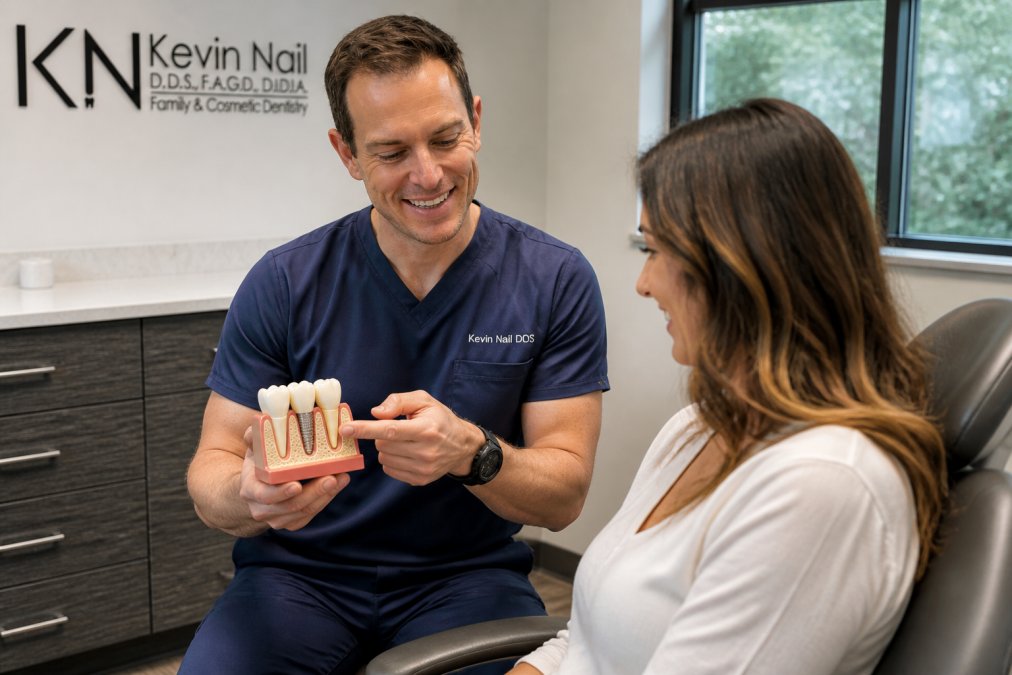
Flapless implant surgery is a minimally invasive approach that places the implant through a small opening in the gum without lifting a full tissue flap. For missing teeth replacement, the main benefits are less post-operative swelling and bleeding, a shorter recovery window, and a lower risk of disturbing the gum tissue around adjacent teeth.
Hidden Costs and Fee Transparency in Implant Dentistry
Hidden costs in implant dentistry almost always come from three places: extractions, grafting, and the restoration itself. A transparent provider itemizes each of these before treatment begins.
Questions worth asking at every consultation:
- Does the quoted price include the abutment and final crown?
- Is bone grafting or a sinus lift likely, and what does that add?
- Are there charges for follow-up visits or adjustments?
- What happens financially if the implant fails to integrate?
How to Choose a Reputable Provider for Affordable Dental Implants in Houston
Choosing a provider for affordable dental implants in Houston comes down to training, imaging technology, and whether the person quoting your treatment is the person performing it.
Evaluate any practice against these criteria:
- Is the dentist board-certified or a Diplomate of a recognized implant association?
- Does the practice use 3D cone beam imaging rather than two-dimensional X-rays alone?
- Will the same dentist perform the surgery, or is it referred out?
- Are fees itemized in writing before treatment?
- Does the practice handle restorative dentistry and routine care under one roof?
- Are staff members long-term, so you see familiar faces at follow-ups?
Frequently Asked Questions
What factors influence the total price of affordable dental implants in Houston?
The total price depends on several clinical and material factors. Key variables include the number of implants needed, the type of final restoration (such as a crown or implant-supported dentures), and whether preparatory procedures like bone grafting or a sinus lift are required. The specific implant system used and the provider's level of surgical training also affect the fee. Because every case is unique, a consultation with 3D cone beam imaging is needed to determine your exact treatment plan and cost.
Are there dental implant financing options available if I can't afford the full amount upfront?
Yes, many practices offer dental implant financing options to make treatment more accessible. These often include monthly payment plans through third-party healthcare lenders or in-house payment schedules. Some patients also use medical financing or health savings accounts. It is best to ask the practice directly about their transparent billing and available payment structures during your patient consultation to find a plan that fits your budget.
Does dental insurance typically cover the cost of dental implants?
Dental insurance coverage for implants varies widely. Some PPO plans may cover a portion of the restorative component, such as the crown or abutment, but often exclude the surgical placement of the titanium post. Coverage is frequently categorized under major restorative dentistry. Because policies differ, your provider's office can help verify your specific benefits and explain any out-of-pocket expenses before you begin treatment.
What is the recovery time for flapless implant surgery compared to traditional methods?
The dental implant procedure recovery time for flapless surgery is often shorter than traditional methods. Because flapless techniques avoid cutting and lifting the gum tissue, patients typically experience less post-operative swelling, bleeding, and discomfort. Many people return to normal activities within a few days. However, osseointegration, the process where the bone fuses with the implant, takes several months before the final restoration is placed.
Replacing missing teeth shouldn't mean choosing between quality and a bill you can manage. At Kevin Nail DDS, Dr. Nail personally performs every procedure using minimally invasive flapless implant techniques and 3D cone beam imaging, with long-term staff who know patients by name. Call 281-550-9054 to schedule a consultation and get a clear, itemized plan for your smile reconstruction.