 how-to
Avoiding Swelling After Dental Implants: A 2026 Guide
Table of Contents
- How to Reduce Facial Swelling After Oral Surgery: What You'll Need
- Step 1: Start Cold Compresses in the First 24 Hours
- Step 2: Elevate Your Head and Get Sleeping Position Ergonomics Right
- A Realistic Dental Implant Recovery Timeline
- Step 3: Pain Management After Dental Implants and Medication Interactions
- Step 4: Hydration, Soft Foods, and Gentle Oral Hygiene
- Common Mistakes That Make Swelling After Dental Implants Worse
- When to Contact Your Dentist About Swelling After Dental Implants
- Frequently Asked Questions
Last Updated: September 10, 2026
How to Reduce Facial Swelling After Oral Surgery: What You'll Need
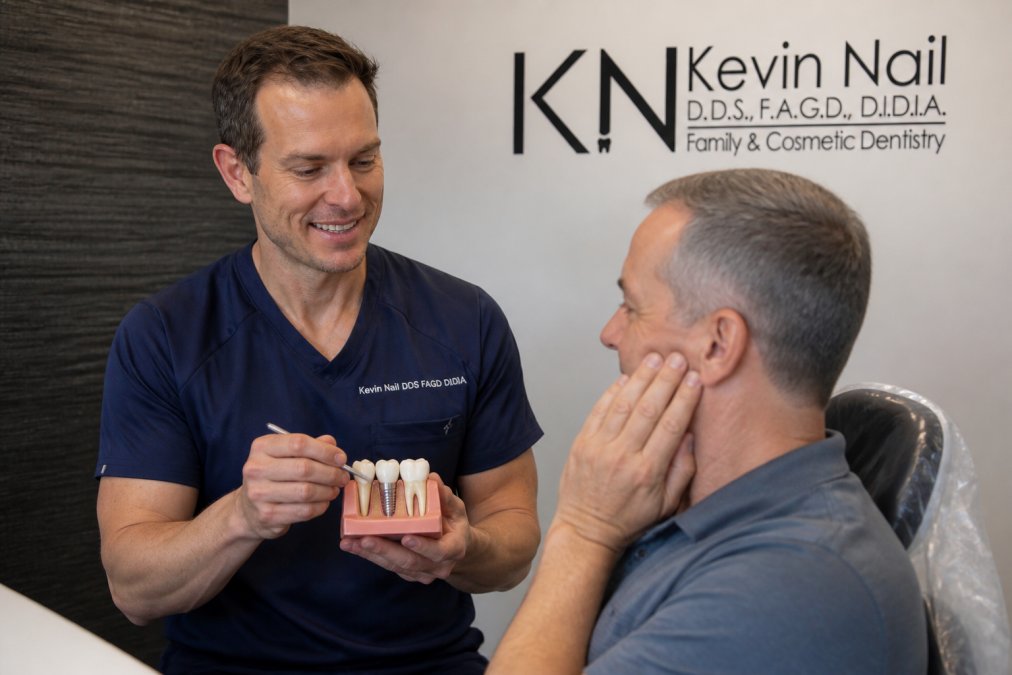
Swelling after dental implants is a normal part of healing, not a sign that something went wrong. At Kevin Nail DDS, we tell patients in Copperfield and greater Houston to expect facial swelling to peak within the first 48 to 72 hours, then taper steadily over the following week. The goal isn't to eliminate swelling entirely. It's to keep it controlled, comfortable, and within the range a healing body produces.
Here's the practical toolkit we recommend before your procedure, so you're not scrambling the night of surgery:
- Two reusable cold packs or gel packs, plus a thin cloth barrier
- An extra pillow or two, or a wedge pillow for head elevation
- Prescribed pain medication and any over-the-counter options your dentist approves
- Soft foods: yogurt, mashed potatoes, smoothies, scrambled eggs, applesauce
- A squeeze bottle or syringe for gentle rinsing, if your dentist provides one
- A notepad or phone to track medication timing and symptom changes
The 24-48 hour window after surgery is when cold therapy matters most. After that, the strategy shifts. Below, we'll walk through each step in order, plus the mistakes that quietly make swelling worse.
Step 1: Start Cold Compresses in the First 24 Hours
Cold therapy is the single most effective tool you have in the first day. Apply a cold compress to the outside of your cheek for 20 minutes on, 20 minutes off, repeating through the day (the American Dental Association). The cold narrows blood vessels near the surface, a process called vasoconstriction, which limits fluid buildup around the surgical site.
Wrap the pack in a thin towel. Never place ice directly against bare skin, and don't fall asleep with a pack in place.
Your dentist's post-operative instructions from the American Dental Association will confirm timing specific to your procedure. Most patients find that consistent 20-on, 20-off cycles for the first 24 hours keep facial swelling noticeably more manageable than sporadic icing.
Step 2: Elevate Your Head and Get Sleeping Position Ergonomics Right
Sleeping position matters more than most patients expect. Keep your head elevated above heart level for the first two to three nights, using two stacked pillows or a wedge pillow. Gravity helps fluid drain away from your face instead of pooling at the incision site overnight.
Back sleeping is the safest choice. If you normally sleep on your side, try a travel pillow to keep your head from rolling toward the surgical side.
A Realistic Dental Implant Recovery Timeline
A dental implant recovery timeline typically runs seven to ten days for visible swelling, with the sharpest changes in the first three days. What most timelines leave out is what the swelling actually looks like day by day, which is the part patients worry about most. Here is a visual progression guide you can check yourself against.
| Timeframe | What You'll See | What You'll Feel | What to Do |
|---|---|---|---|
| Day 0 (surgery day) | Minimal swelling at first; cheek may look normal for several hours | Numbness wearing off, pressure at the site | Start cold compresses, rest, head elevated |
| Day 1 | Visible puffiness on the surgical side, sometimes extending toward the eye | Peak discomfort, tightness, mild bruising may appear | Continue 20-on/20-off cold therapy, limit activity |
| Day 2 | Swelling at its fullest; bruising, if any, is most colorful | Stiffness, soreness, difficulty opening wide | Keep icing, stay hydrated, take medication on schedule |
| Day 3 | Swelling holds steady or eases slightly; bruising starts to fade toward yellow-green | Discomfort noticeably better | Ask your dentist about switching to warm compresses |
| Days 4-5 | Swelling visibly receding; cheek contour returning | Mild soreness, some tenderness at the site | Gentle saltwater rinses, soft foods, resume light hygiene |
| Days 6-7 | Most visible swelling gone; any remaining puffiness is subtle | Occasional twinge, mostly comfortable | Normal soft diet, follow-up as scheduled |
| Week 2+ | Facial contour back to baseline | Residual tenderness only | Resume normal hygiene and activity per your dentist |
How to read this guide.
- Peak is day 2, not day 1. Many patients panic on the morning after surgery because swelling is already visible, then panic again on day 2 when it looks worse. That climb is expected. The number to watch is day 3: swelling should hold steady or start to ease, not keep climbing.
- Bruising is normal and not a warning sign. A yellow-green tint around day 3 to 5 is just blood breakdown products being reabsorbed. It fades on its own.
- Asymmetry is normal. One side of your face will look puffier than the other if that is the surgical side. Comparing the two sides to each other is less useful than comparing today to yesterday.
That 72-hour mark is the point where many dentists switch from cold to warm compresses. Warmth encourages vasodilation, which supports lymphatic drainage and helps the body clear built-up fluid. Ask your dentist before making the switch, since timing depends on your specific procedure.

Step 3: Pain Management After Dental Implants and Medication Interactions
Pain management after dental implants usually combines a prescribed medication with an over-the-counter option, and the interaction between the two matters more than most patients realize. The reason comes down to how each drug works, not just how strong it is.
Two different jobs, two different drugs.
- Ibuprofen (Advil, Motrin) and naproxen (Aleve) are NSAIDs. They block the COX-1 and COX-2 enzymes, which is the same pathway that produces both pain signals and the prostaglandins driving inflammation and fluid buildup. In other words, an NSAID does double duty: it dulls pain and it blunts the swelling response itself.
- Acetaminophen (Tylenol) works mostly in the central nervous system. It relieves pain and reduces fever, but it has essentially no anti-inflammatory effect. It will not reduce swelling on its own.
That distinction is why many dentists recommend a scheduled NSAID as the backbone of the first 48 to 72 hours, with acetaminophen added or alternated for breakthrough pain. A common pattern is 400 to 600 mg of ibuprofen every 6 hours, with 500 to 1,000 mg of acetaminophen every 6 hours offset by 3 hours, so something is always working (peer-reviewed research). Your dentist will set the actual doses based on your weight, kidney and liver function, and what was prescribed.
Why you should not simply stack them.
- NSAIDs carry a ceiling effect. Beyond a certain dose, more ibuprofen does not mean more relief, but it does mean more stomach irritation and kidney load.
- Acetaminophen has a hard daily maximum. Exceeding it, even accidentally through combination cold remedies, is a leading cause of acute liver injury.
- Taking an NSAID on top of a prescription opioid that already contains acetaminophen (common in combination pain pills) can push you past the acetaminophen limit without you noticing.
Who needs a modified plan.
Blood thinners, certain blood pressure medications, some antidepressants, and a history of stomach ulcers, kidney disease, or aspirin-sensitive asthma all change the calculus. If any of these apply, tell your dentist before surgery, not after. A medication that thins blood may prolong bleeding and alter how quickly inflammation settles, and some patients are better served by acetaminophen alone or a different prescription entirely.
Never add an over-the-counter anti-inflammatory on top of a prescription without asking first. Doubling up is one of the most common reasons patients call us with unexpected symptoms.
Step 4: Hydration, Soft Foods, and Gentle Oral Hygiene
Hydration does more for swelling than most patients realize. Water supports lymphatic drainage, the system your body uses to move excess fluid away from tissue. Aim to sip steadily through the day, especially in the first 48 hours when you may not feel like eating or drinking much.
A soft food diet protects the surgical site while you heal. Good choices include:
- Greek yogurt and cottage cheese
- Blended soups, cooled to room temperature
- Mashed sweet potatoes or regular mashed potatoes
- Protein smoothies without seeds or crunchy add-ins
- Scrambled eggs and soft-cooked oatmeal
Skip anything hot, spicy, crunchy, or straw-based for the first week. Straws create suction that can dislodge a clot at the incision site.
For oral hygiene, avoid brushing directly over the surgical area for the first day. After 24 hours, your dentist may have you begin gentle saltwater rinses: a quarter teaspoon of salt in a cup of warm water, swished softly and allowed to fall out of your mouth rather than spit forcefully. Gentle rinsing keeps the area clean without disturbing healing tissue.
Common Mistakes That Make Swelling After Dental Implants Worse
The biggest mistake is treating the first day casually. Patients who skip cold compress cycles, sleep flat, or jump back into normal activity within hours tend to see more pronounced swelling by day two.
Other common missteps we see:
- Using heat too early. Warm compresses feel soothing, but in the first 48 hours they can increase blood flow to the area and worsen swelling. Wait for your dentist's go-ahead.
- Strenuous activity too soon. Exercise raises blood pressure and heart rate, which pushes more fluid toward the face. Take it easy for at least 48 to 72 hours.
- Skipping medications to "tough it out." Staying ahead of discomfort is easier than catching up to it. Take medication on schedule, not just when pain spikes.
- Smoking or vaping. Both reduce blood flow to healing tissue and slow recovery. This is one of the most consistent factors in prolonged swelling.
- Aggressive rinsing or spitting. Forceful motion can dislodge the protective clot. Keep rinses gentle.
Patient compliance with these basics makes a bigger difference than most people expect. Following them consistently is often the difference between a comfortable week and a frustrating one.
When to Contact Your Dentist About Swelling After Dental Implants
Call your dentist if swelling increases after day three instead of decreasing, if it spreads to your neck or under your jaw, or if you develop a fever, pus, or a foul taste near the incision site. These can signal infection rather than normal post-surgical inflammation.
Mild swelling that peaks around 48 hours and eases from there is expected. Swelling that keeps climbing past the 72-hour mark is not.
At Kevin Nail DDS, Dr. Kevin Nail utilizes advanced, minimally invasive techniques like flapless implant surgery to ensure precision and patient comfort. He uses 3D cone beam CT scans for sub-millimeter precision.
If you're in the greater Houston area and want a dentist who personally performs every procedure, from your kids' cleanings to your implant placement, Kevin Nail DDS offers comprehensive care under one roof.
Frequently Asked Questions
When is swelling the worst after a dental implant?
Swelling typically peaks around 48 to 72 hours after implant placement, then begins to ease. The first 24 hours often show only mild puffiness because the body's initial response is vasoconstriction, which narrows blood vessels. As vasodilation takes over, fluid moves into the tissue and facial swelling increases. Cold compress use during that early window helps limit how much fluid accumulates, which is why timing matters more than intensity.
How to reduce swelling after dental implants?
Apply a cold compress for 20 minutes on and 20 minutes off during the first 24 to 48 hours. Sleep with your head elevated on two or three pillows. Drink water steadily, eat soft foods, and avoid strenuous activity, alcohol, and smoking. Around the 72-hour mark, many dentists suggest switching to warm compresses to support lymphatic drainage. Gentle saltwater rinses after 24 hours help keep the surgical site clean without disturbing the incision.
How many days should I rest after a dental implant?
Most patients take it easy for 24 to 48 hours and return to desk work within two to three days. Avoid heavy lifting, running, and bending over for at least 72 hours, since increased blood pressure can push more fluid into the surgical site. If your procedure involved a bone graft or multiple implants, plan for a longer rest period. Your dentist will give you specific activity restriction guidance based on your case.
What foods should I avoid after dental implant surgery?
Skip crunchy, chewy, spicy, and very hot foods for the first week. Also avoid straws, which create suction that can dislodge a clot, and steer clear of alcohol and caffeine because they can increase bleeding and slow healing. Stick to a soft food diet: yogurt, scrambled eggs, mashed potatoes, smoothies eaten with a spoon, and cooled soups. Hydration matters too, so sip water regularly between meals.
Swelling after dental implants is manageable when you know what to expect and act early. Cold therapy, head elevation, hydration, and honest communication with your dentist about medications and symptoms do most of the work. If you're considering implants or want a recovery plan built around your health history, call Kevin Nail DDS at 281-550-9054 to schedule a consultation and get answers specific to your case.