 ultimate-guide
Benefits of Flapless Implant Surgery: A 2026 Guide
Table of Contents
- What Is Flapless Implant Surgery?
- Flapless vs. Flapped Implant Surgery: Key Differences
- Core Benefits of Flapless Implant Surgery
- Guided Implant Surgery and Precision Imaging
- Patient Selection and Indications for Flapless Surgery
- Postoperative Healing and What to Expect
- Long-Term Success Rates and Implant Stability
- Frequently Asked Questions
Last Updated: September 24, 2026
What Is Flapless Implant Surgery?
Flapless implant surgery is a minimally invasive dental procedure in which an implant is placed without reflecting the gingival tissue or creating a traditional surgical flap. Instead of lifting the soft tissue away from the bone to expose the surgical site, the dentist uses advanced imaging and specialized instruments to create a precise pathway directly through the gum to the bone. This technique allows for implant placement with minimal tissue disruption and is particularly effective when supported by 3D cone beam CT (CBCT) imaging for sub-millimeter accuracy.
Traditional flapped surgery requires cutting and peeling back the gingiva to visualize the bone and surgical field. Flapless surgery bypasses this step entirely, using CBCT imaging to plan implant placement with precision before surgery, allowing execution with minimal disruption to soft tissue and bone architecture.
Flapless surgery prioritizes tissue preservation and patient comfort over maximum visibility, demanding higher skill and advanced imaging technology but delivering reduced bleeding, faster healing, and more comfortable recovery.
Flapless vs. Flapped Implant Surgery: Key Differences
| Factor | Flapless Surgery | Flapped Surgery |
|---|---|---|
| Tissue Reflection | No flap created; minimal soft tissue disruption | Gingiva reflected to expose bone |
| Surgical Trauma | Minimal; limited tissue handling | Greater; requires tissue elevation and suturing |
| Bleeding | Significantly reduced | More pronounced due to exposed blood vessels |
| Recovery Time | Faster; typically 3-5 days for initial healing | Longer; 1-2 weeks for initial swelling to subside |
| Postoperative Discomfort | Mild swelling and minimal pain | Moderate to significant swelling for 5-7 days |
| Imaging Requirements | Mandatory CBCT for surgical planning | Standard radiographs often sufficient |
| Surgical Precision | High; sub-millimeter accuracy possible | Dependent on surgeon visualization |
| Soft Tissue Preservation | Excellent; architecture maintained | Some loss of soft tissue contour possible |
| Suturing Complexity | Minimal or no sutures required | Multiple sutures needed to close flap |
| Best For | Patients seeking comfort and quick recovery | Complex cases requiring maximum bone visualization |
Flapped surgery provides complete visualization and real-time adjustments but incurs surgical trauma, inflammatory response, and longer recovery. Flapless surgery sacrifices some real-time visualization for dramatically reduced tissue trauma and faster healing.
Core Benefits of Flapless Implant Surgery
The benefits of flapless implant surgery cluster around three primary outcomes: reduced surgical trauma, preservation of the anatomical structures that support long-term implant success, and dramatically faster recovery. These advantages compound over the patient's healing timeline.
Reduced Surgical Trauma and Bleeding
Traditional flapped surgery creates significant trauma through gingival reflection, causing bleeding, tissue damage, and inflammatory response that drives postoperative swelling, pain, and delayed healing.
Flapless surgery eliminates flap reflection, keeping blood vessels undisturbed, minimizing bleeding and inflammatory response. The surgical site heals as a small puncture wound rather than a large surgical wound.
Reduced surgical trauma translates to less inflammation, swelling, and pain, with faster return to normal function. Flapless patients often forget about the procedure within 48 hours versus 5-7 days of discomfort with flapped surgery.
Preservation of Soft Tissue and Bone Architecture
Gingival tissues and underlying bone create the foundation for long-term implant health. Flap reflection causes some loss of soft tissue attachment and alters bone contour through trauma of elevation and suturing.
Flapless implant surgery preserves critical structures since gingiva is never reflected, maintaining soft tissue attachment and architecture. This delivers better peri-implant health, more stable soft tissue contours, and more natural appearance.
Bone resorption is minimized with less surgical trauma, as undisturbed vascular supply supports better osseointegration and stable bone levels. Preserved bone architecture provides better options for future implant work.
Faster Dental Implant Recovery Time
Flapless implant surgery recovery is notably accelerated, with initial healing typically within 3-5 days versus 1-2 weeks for flapped surgery.
Faster recovery means patients return to work, exercise, and normal eating sooner. Most patients resume light activity within 24-48 hours and normal function by day 5.
Accelerated recovery supports better patient compliance with postoperative care, directly correlating with better implant outcomes.
Guided Implant Surgery and Precision Imaging
Guided implant surgery and flapless technique are deeply interconnected. Flapless surgery requires precision that traditional visualization cannot provide; CBCT imaging and surgical guides fill this requirement.
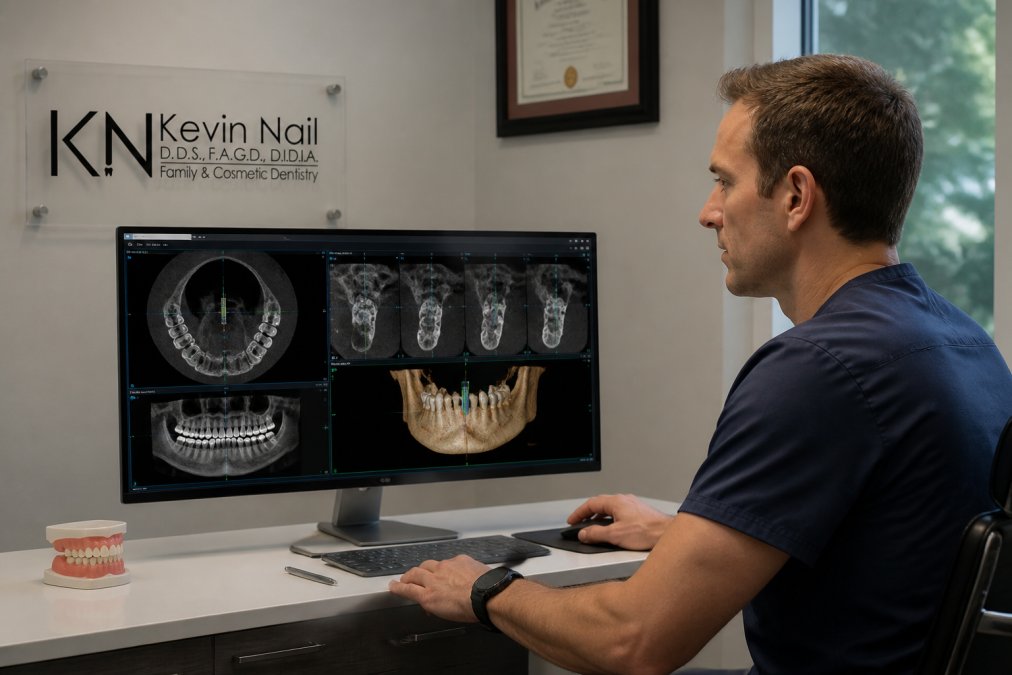
CBCT imaging captures a three-dimensional model of the jaw, bone quality, bone volume, and the relationship between the implant site and critical anatomical structures like the inferior alveolar nerve and maxillary sinus. This imaging allows the surgeon to plan the exact implant position, angle, depth, and diameter before making any incision.
Patient Selection and Indications for Flapless Surgery
Not every patient is a candidate for flapless implant surgery. Patient selection criteria determine whether the technique will succeed or whether a traditional flapped approach is more appropriate.
Ideal candidates for flapless surgery share several characteristics:
- Adequate bone volume and quality. The bone must be sufficiently thick and dense to support implant placement without augmentation. CBCT imaging confirms bone dimensions before surgery.
- Single implant placement or straightforward multiple implants. Flapless surgery works well for replacing one tooth or several teeth in a planned sequence. Complex full-mouth cases may benefit from flapped surgery's superior visualization.
- Healthy periodontal status. Patients with existing gum disease or severe bone loss are typically better served by traditional surgery, which allows for bone grafting and periodontal management.
- Realistic expectations about healing. Patients who understand that flapless surgery prioritizes comfort and speed over maximum bone visibility tend to have the best outcomes.
- Good oral hygiene commitment. Because soft tissue is preserved rather than surgically managed, the patient's ability to maintain the implant site is critical.
Postoperative Healing and What to Expect
Understanding the postoperative timeline helps patients manage expectations and follow care instructions that support optimal healing.
Long-Term Success Rates and Implant Stability
The ultimate measure of any implant technique is long-term success: does the implant integrate with bone, remain stable, and support a functional restoration for decades?
Frequently Asked Questions
What are the primary benefits of flapless implant surgery compared to traditional methods?
Flapless implant surgery avoids the reflection of gingival tissue, which means less surgical trauma, reduced bleeding, and minimal disruption to the vascular supply of the surgical site. This translates to less postoperative swelling and discomfort, faster healing times, and better preservation of the soft tissue and bone architecture around the implant. Patients typically experience less pain and can return to normal activities more quickly than with traditional flapped surgery.
How does flapless implant surgery reduce dental implant recovery time?
By eliminating the need to reflect soft tissue flaps, the surgical site experiences less trauma and inflammation. This minimizes postoperative discomfort and allows osseointegration to proceed without the extended swelling typical of flapped procedures. Most patients report significantly reduced recovery time, though individual healing varies. Your dentist can provide a specific timeline based on your bone volume, overall health, and the complexity of your implant placement.
Are there specific patient criteria that make someone a candidate for flapless implant surgery?
Ideal candidates have adequate bone volume and gingival architecture, good oral hygiene, and realistic expectations about the procedure. Patients with sufficient bone density and healthy periodontal tissues are better suited for this technique. Those with severe bone resorption, significant bone grafting needs, or complex anatomical contraindications may not be candidates. A consultation with a qualified implant dentist, supported by 3D CBCT imaging, is essential to determine if you meet the indications for flapless surgery.
What imaging is required before flapless implant surgery?
Cone beam CT (CBCT) scanning is critical for flapless implant placement because it provides three-dimensional visualization of bone volume, bone density, and anatomical landmarks with sub-millimeter precision. This guided implant surgery approach allows your dentist to plan the exact implant position, angle, and depth before surgery begins, reducing the risk of surgical complications and ensuring optimal implant stability. CBCT imaging is the standard for minimally invasive implant planning.
What should I expect during postoperative healing after flapless surgery?
Because flapless surgery minimizes soft tissue reflection and surgical trauma, postoperative swelling and discomfort are typically mild compared to traditional flapped procedures. You may experience some minor swelling or bruising in the first few days, but most patients report minimal pain. Healing progresses quickly, and many people return to normal activities within a few days. Your dentist will provide specific aftercare instructions and a timeline for when you can resume eating solid foods and normal oral hygiene.
Does flapless implant surgery affect long-term implant success rates?
Flapless implant surgery achieves comparable long-term success rates to traditional flapped surgery when performed by a qualified implant dentist with proper patient selection. The minimally invasive approach preserves bone and soft tissue architecture, which supports peri-implant health and implant stability over time. Clinical outcomes depend on osseointegration, bone-implant contact, and your commitment to oral hygiene and follow-up care. Ask your dentist about their clinical outcomes and success rates for flapless procedures.
What are the main limitations or risks of flapless implant surgery?
Flapless surgery requires excellent surgical precision and is best suited to patients with adequate bone volume and healthy soft tissue. It is not appropriate for cases requiring extensive bone grafting or complex surgical access. There is a slightly higher learning curve for the surgical team. Potential complications include implant malposition if imaging or planning is inadequate, and some patients may still experience postoperative discomfort if bone density is poor. Careful patient selection and advanced imaging minimize these risks.