 Ultimate guide
Are Porcelain Veneers Worth the Investment?
Last Updated: November 16, 2026
Quick Summary
Porcelain veneers are worth the investment when your goal is a durable, stain-resistant change to the color, shape, or alignment of several teeth, and you accept that enamel removal is permanent. They carry the highest upfront cost, so compare the total fee per year of service against bonding, crowns, whitening, or orthodontics before you commit.
- Veneers treat discoloration, chips, cracks, worn edges, small gaps, and mild misalignment, not bite or gum disease.
- Placement usually requires removing a small amount of enamel, and that removal is permanent.
- Porcelain veneers typically last 10-15+ years, while composite bonding lasts 3-7 years.
- Most dental plans classify veneers as elective cosmetic treatment and exclude them.
- Divide the total fee by expected years of service to compare options on cost per year.
Table of Contents
- What Porcelain Veneers Are and What They Treat
- Porcelain Veneers Pros and Cons: The Honest Trade-Offs
- How Long Do Porcelain Veneers Last?
- Porcelain Veneers Cost Breakdown: What You Actually Pay For
- Veneers vs. Bonding, Crowns, and Whitening: Alternatives Compared
- The Lifetime Cost of Ownership: Repair, Replacement, and Value
- Risks, Reversibility, and Candidacy: Who Should Say No
- How to Evaluate a Dentist and a Veneer Treatment Plan
- Frequently Asked Questions
What Porcelain Veneers Are and What They Treat
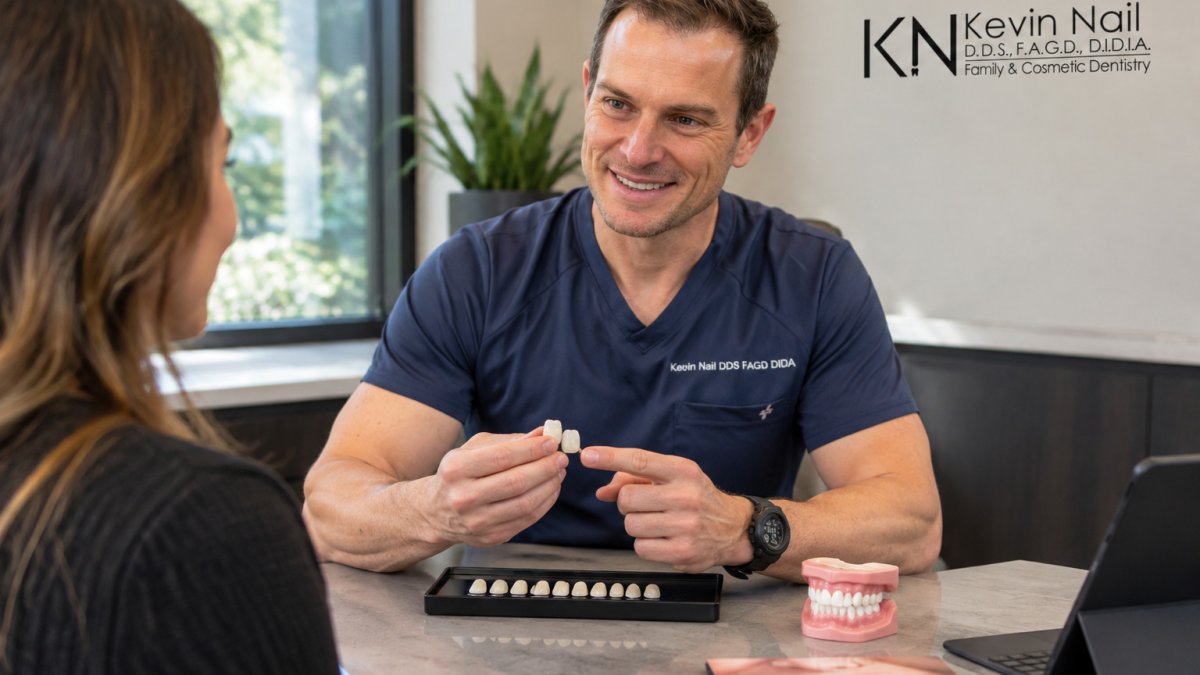
Porcelain veneers are thin, custom-made shells of dental ceramic bonded to the front surfaces of teeth to change their shape, color, or alignment.

Veneers address cosmetic imperfections rather than disease. The typical list includes discoloration that whitening cannot lift, chips, cracks, worn edges, small gaps, and mild misalignment.
The distinction matters because veneers are often marketed as a general fix. They are not. If you want to explore what cosmetic dentistry can do for your smile, you can review the practice's cosmetic dentistry services and see how a consultation works.
Porcelain Veneers Pros and Cons: The Honest Trade-Offs
The strongest argument for porcelain veneers is appearance and stain resistance. Dental ceramic is often described as mimicking the light behavior of natural tooth enamel, and its glaze is generally more resistant to staining from coffee, tea, and red wine than composite resin.
The honest drawbacks come down to commitment. Placing a veneer usually requires removing a small amount of enamel from the front of the tooth, and that removal is permanent (Veneers | MouthHealthy). Once a tooth is prepared, it will always need some form of restoration.
If you want the step-by-step picture before weighing the trade-offs, our guide on the process for dental veneers walks through consultation, preparation, temporaries, and bonding.
How Long Do Porcelain Veneers Last?
Porcelain veneers are often described as lasting many years with proper care, and actual longevity varies by patient. The range depends more on the patient than the material: bite forces, grinding habits, hygiene, and whether you attend regular dental checkups all move the number.
What shortens lifespan fastest is parafunctional stress. Clenching and bruxism load the bonding interface and the ceramic itself, and a night guard is often the difference between a veneer that lasts a decade and one that chips in year three. Biting fingernails, opening packaging with your teeth, and chewing ice are the other common culprits.
For a fuller breakdown of care, repair, and realistic timelines, read our article on how long advanced dental veneers last with proper care.
Porcelain Veneers Cost Breakdown: What You Actually Pay For
Pricing for porcelain veneers varies by practice, case complexity, and the number of teeth treated, so you should request a written quote from the practice for your specific case. What you are paying for is not just the ceramic.
Veneer fees generally cover diagnosis, a treatment plan, tooth preparation, temporary restorations, laboratory fabrication, and bonding, and the exact inclusions should be confirmed in a written estimate from the practice.
What drives the per-tooth price
Across practices, porcelain veneers commonly fall into a broad range rather than a single number, and the spread is explained by a handful of cost drivers:
-
Material and lab work. Feldspathic, lithium disilicate, and zirconia ceramics carry different lab fees and fabrication steps. A master ceramist and a trial smile add cost but also predictability.
-
Number of teeth. A single veneer is priced higher per unit than a full smile set because diagnosis, smile design, and lab setup are shared across the case.
-
Case complexity. Bite correction, gum contouring, crown lengthening, or orthodontic prep before veneers all add appointments and fees.
-
Temporaries and guards. Provisional veneers and a night guard are sometimes bundled and sometimes billed separately, ask which.
What insurance typically does and does not cover
Most dental plans classify veneers as elective cosmetic treatment and exclude them. Some plans contribute when a veneer restores a damaged tooth for functional reasons, for example, after trauma or to replace a large failing restoration, but the plan may still pay at the restorative, not cosmetic, rate. Ask for a pre-treatment estimate in writing before you commit, and ask whether a pre-authorization can be submitted so you know the out-of-pocket number before preparation begins.
Financing and payment mechanics
Because veneers are usually paid out of pocket, patients often ask about financing or payment plan options, and the practice can explain what it accepts. If you use an HSA or FSA, confirm with the plan administrator that cosmetic veneers qualify, because eligibility rules vary. Ask whether any discount applies for paying in full and whether the quoted fee includes the trial smile, temporaries, and any post-bonding adjustment visits.
Watch out: a quote that excludes temporaries, the night guard, or remake fees can look lower than a competitor's all-in price and end up costing more.
The number that actually matters
A per-tooth price is only half the investment picture. Divide the total fee by the expected years of service, and add likely repair and replacement costs, to get a cost per year of wear. That framing is what lets you compare porcelain against bonding, whitening, or orthodontics on equal terms, and it is the calculation we walk through in the lifetime cost section below.
Veneers vs. Bonding, Crowns, and Whitening: Alternatives Compared
No single option wins across the board. The right choice depends on how much tooth structure is left, how much change you want, and how long you expect it to hold. The table below compares the realistic alternatives on the three dimensions that decide value: cost, invasiveness, and longevity. Because longevity is central to weighing cost against invasiveness, Smiles of San Marcos can help frame how long porcelain veneers may remain a worthwhile choice.
| Option | Relative Cost | Invasiveness | Typical Longevity | Best For |
|---|---|---|---|---|
| Porcelain veneers | Highest upfront | Moderate; some enamel removal, irreversible | 10-15+ years | Color, shape, and alignment changes across several teeth |
| Composite bonding | Lowest upfront | Minimal to none; additive and largely reversible | 3-7 years | Small chips, minor gaps, budget cases |
| Crowns | High | High; significant tooth reduction | 10-15+ years | Structurally compromised or root-treated teeth |
| Whitening | Lowest | None | Months to a few years | Color only, with healthy enamel |
| Orthodontics | Moderate to high | None to teeth; moves roots | Lifetime with retention | Crowding, spacing, and bite problems |
| No treatment | None | None | N/A | Stable, healthy teeth with concerns you can live with |
Reading the table like an investor
Whitening is the least invasive and the cheapest entry point, but it does nothing for shape or chips, and results fade. Bonding is fast and largely reversible because it adds material rather than removing it, though composite stains and wears faster, so it usually needs refresh within a few years. Crowns solve structural problems veneers cannot, at the cost of more tooth reduction. Orthodontics addresses the underlying position of teeth rather than masking it, which matters when the real issue is crowding or a bite problem rather than color or shape.
The gap most comparisons miss: matching the treatment to the diagnosis
Veneers are often marketed as a general smile fix, but the honest comparison starts with what is actually wrong. Discoloration that whitening cannot lift points toward veneers or crowns. Chips and small gaps point toward bonding first. Crowding and bite problems point toward orthodontics, sometimes followed by whitening or bonding rather than veneers.
That diagnosis-first framing is the unique angle here: the investment question is not "veneers or bonding" in the abstract, but "which option matches my specific problem at the lowest lifetime cost." If you are weighing bonding specifically, our cost-benefit breakdown of whether teeth bonding is worth the cost covers the trade-offs in detail.
Watch out: choosing veneers to fix alignment that orthodontics would correct can mean removing healthy enamel to solve a problem that did not require it.
The Lifetime Cost of Ownership: Repair, Replacement, and Value
The number that matters is not the first invoice. It is the total you spend across the life of the restoration.
Porcelain veneers are rarely a one-time purchase. Over a 20-year horizon, most patients face at least one repair for a chipped or debonded unit and eventually a full replacement set.
Composite bonding, by contrast, has a lower entry point but a shorter cycle. It typically needs refresh or replacement more often, so the gap between the two narrows over time.
Long-term value also depends on diagnosis. A veneer placed over untreated gum disease or an unstable bite will fail early regardless of the ceramic used, which is why a thorough exam comes before any cosmetic plan.
Risks, Reversibility, and Candidacy: Who Should Say No
Veneers are generally considered irreversible because enamel removed during preparation does not grow back, so the decision is permanent even if the veneer itself is later replaced. That single fact should shape how you think about the procedure.
The main risks are predictable. Chipping and debonding under heavy bite forces. Sensitivity in the prepared teeth, usually temporary. Margin problems if the fit or the bonding is imperfect. Gum irritation if margins sit too close to the tissue.
Candidacy is the filter. Good candidates have healthy gums, no active decay, enough enamel to bond to, and a stable bite. People who grind heavily need a guard and a frank conversation about longevity. Anyone with uncontrolled gum disease, significant decay, or a bite that has not been assessed should treat that first.
How to Evaluate a Dentist and a Veneer Treatment Plan
The provider matters as much as the material, and the treatment plan can indicate the approach a provider takes.
Look for a plan that starts with a full exam, including gum health and bite assessment, before anyone talks about shade.
A few questions worth putting in writing:
- How many teeth do you recommend treating, and why that number?
- What is the plan if my bite needs correction first?
- Which laboratory fabricates the restorations?
- What is the policy on repairs and remakes?
- What will this cost in total, including temporaries and any guard?
For a deeper framework, our guide on choosing the best cosmetic dentist for veneers covers credentials, case review, and the red flags worth walking away from.
At Kevin Nail DDS, Dr. Kevin Nail personally performs every procedure. Dr. Nail is a Fellowship member of the Academy of General Dentistry (FAGD) and a Diplomate of the International Dental Implant Association.
Veneers can be a sound investment, but only when the diagnosis, the provider, and the plan all line up.
Frequently Asked Questions
What is the downside of getting porcelain veneers?
The main downsides are that the process is irreversible because a thin layer of tooth enamel is removed, and the cost per tooth is higher than bonding. Veneers can chip or debond under heavy bite force or bruxism, and they need replacement eventually. Some patients also notice temporary sensitivity after placement. A consultation can help confirm whether your enamel and bite are suitable for veneers.
How much should I expect to pay for a full set of porcelain veneers?
Porcelain veneers are typically priced per tooth, and a full set covering the visible front teeth multiplies that per-tooth figure across 6 to 10 units or more. Because pricing varies by practice, materials, and the number of teeth treated, ask for a written porcelain veneers cost breakdown at your consultation. Ask whether that estimate separates the veneers themselves from exams, imaging, and any prep work. Insurance usually treats veneers as elective, so financing options are worth asking about.
What happens after 20 years with veneers?
Porcelain veneers are often described as lasting many years with good care, and longevity varies by patient. Expect some veneers to have been repaired or replaced individually along the way. The teeth underneath remain healthy if you keep up brushing, flossing, and regular dental checkups. A dentist can assess bonding margins and wear at checkups, and replacement is generally easier to plan than an emergency repair.
Are there non-invasive alternatives to porcelain veneers?
Yes. Composite bonding generally adds resin to the tooth with little or no enamel removal, though it can stain more easily and may need polishing or replacement sooner. Teeth whitening addresses discoloration without changing tooth shape. Clear aligners can close gaps or correct mild misalignment. Crowns are more invasive but suit teeth with large damage. A dentist can compare these by cost, invasiveness, and longevity so you choose the least invasive option that meets your goals.