 Ultimate guide
Long Term Success Rates of Flapless Dental Implants
Last Updated: November 11, 2026
Quick Summary
Long term success rates of flapless dental implants depend on whether a study measures survival or full success, and on follow-up length. Most flapless-specific data covers one year, while 10+ year evidence is weaker and often pooled with flap surgery. Check the outcome definition, follow-up, and dropout rate before trusting any figure.
- Survival means the implant is still present; success also requires function, stable bone, and no infection.
- Early failures cluster around healing and integration, while later failures lean toward peri-implantitis and overload.
- Flapless placement suits adequate bone volume with no need for simultaneous grafting or sinus elevation.
- Guided surgery with 3D imaging reduces positional risk but does not eliminate it.
- Smoking, uncontrolled diabetes, and periodontal history change the plan and recall schedule, not automatic disqualification.
Table of Contents
- What Long Term Success Rates of Flapless Dental Implants Actually Measure
- Flap vs Flapless Implant Surgery: How the Techniques Differ
- Long Term Outcomes Broken Down by Follow-Up Period
- Flapless Implant Surgery Risks and Complications to Know
- Dental Implant Failure Causes and Patient-Level Risk Factors
- Flapless Implant Recovery Time and Postoperative Morbidity
- Who Is a Good Candidate for Flapless Implant Placement
- Book a Flapless Implant Consultation with Dr. Kevin Nail
- Frequently Asked Questions
What Long Term Success Rates of Flapless Dental Implants Actually Measure
Long term success rates of flapless dental implants describe how often implants placed without raising a surgical flap remain in place and function well over years of follow-up.
Flapless dental implant placement is a surgical technique in which the implant is inserted through a small opening in the gum tissue rather than by lifting a full flap to expose the bone.
A headline number that sounds reassuring may describe survival rather than success. Those are not the same measurement, and the gap between them matters when you are deciding on treatment.
Survival Versus Success: Why the Numbers Differ
Implant survival means the implant is still physically present in the mouth. Implant success is stricter: the implant stays in place, functions under load, shows acceptable bone levels, and produces no persistent symptoms or infection.
An implant can survive while failing on every other count. A patient living with discomfort around a stable fixture still counts as a survival statistic. That is why a survival percentage alone tells you less than it appears to.
When you read a clinical study, check three things before trusting the number:
- What outcome was measured: presence of the implant, or a full success definition
- How long patients were followed: one year and ten years are different claims
- How many patients dropped out: high dropout weakens the estimate
We treat these as the questions that separate a meaningful figure from a marketing line.
Flap vs Flapless Implant Surgery: How the Techniques Differ
The core difference between flap and flapless implant surgery is access. Conventional implant surgery lifts a mucoperiosteal flap to see the alveolar ridge directly.
That trade has real consequences. Direct visualization gives the surgeon freedom to adjust position mid-procedure.
For a deeper comparison of technique benefits, our guide to the benefits of flapless implant surgery walks through the clinical reasoning in more detail.
| Feature | Flap Surgery | Flapless Surgery |
|---|---|---|
| Gum tissue | Lifted and reflected | Left intact |
| Visualization | Direct view of bone | Planned on 3D imaging |
| Positioning | Adjustable during surgery | Fixed by the plan |
| Soft-tissue disturbance | Greater | Minimal |
| Suited to | Complex anatomy, grafting | Favorable bone volume |
Neither technique is universally better. The right choice depends on bone volume, ridge shape, and whether grafting is needed.
Long Term Outcomes Broken Down by Follow-Up Period
A single lifetime success percentage is not a useful number. Outcomes should be read in bands, because the risks that dominate at one year are not the risks that dominate at ten. The table below shows how to interpret each band and what kind of evidence typically supports it.
| Follow-up band | What it captures | Typical evidence source | How to read the figure |
|---|---|---|---|
| 1 year | Early healing, integration, early failure | Prospective cohort studies, RCTs | Strongest evidence; most flapless-specific data lives here |
| 5 years | Loading response, marginal bone stability, early peri-implant disease | Prospective and retrospective cohorts | Good evidence; fewer flapless-only studies |
| 10+ years | Long-term bone maintenance, peri-implantitis, prosthetic complications | Retrospective cohorts, registry data | Weakest evidence; often pooled with flap surgery |
What changes with time is the mix of risks: early failures cluster around healing and integration, while later failures lean toward peri-implantitis, biomechanical overload, and maintenance gaps.
Survival, Success, and How Studies Define Them
The reason two studies can report very different numbers for the same technique is that they are often measuring different things. A widely used success framework requires an implant to be immobile, free of pain and infection, and to show limited marginal bone loss. Many studies report only survival: the implant is still present. A surviving implant can still have bone loss, discomfort, or unsatisfactory function.
When you read a flapless study, check four things before trusting the number:
- Outcome definition: survival only, or a full success composite
- Follow-up length and completeness: how many patients reached the stated endpoint
- Case selection: favorable ridges only, or consecutive unselected cases
- Technique details: guided versus freehand, immediate versus delayed loading
Watch out: pooled percentages that blend flap and flapless cases, or that mix 1-year and 10-year data, can look authoritative while telling you almost nothing about your own situation.
Marginal Bone Loss and Soft-Tissue Healing
Marginal bone loss is the change in bone height around the implant neck, measured on radiographs over time (Annual bone loss and success rates of dental implants based on radiographic measurements). It is one of the clearest signals of how an implant is tolerating load and bacterial challenge, and it is the measure most often used to separate success from mere survival.
Soft-tissue healing is often discussed as a potential strength of the flapless approach, though the evidence on this point is not conclusive.
Flapless Implant Surgery Risks and Complications to Know
The main risks of flapless implant surgery are positional error, inadequate visualization, and undetected anatomical problems beneath intact gum tissue. These are not rare theoretical concerns. They are the reasons case selection and imaging quality decide outcomes.
Specific complications to discuss with your surgeon:
- Malposition: the implant sits off-angle because the plan was imperfect
- Dehiscence or fenestration: the implant presses through thin bone
- Overheating during drilling: compromised irrigation in a closed field
- Nerve or sinus proximity issues: anatomy not fully appreciated
- Lost guidance: deviation between the planned and actual site
Guided implant surgery with three-dimensional imaging reduces positional risk substantially, but it does not eliminate it. Our companion article on the risks of guided dental implant surgery covers what can still go wrong even with a well-executed plan.
Watch out: the most common mistake is treating flapless as a shortcut. It is a precision technique, and it fails when it is used on anatomy that needed an open approach.
Dental Implant Failure Causes and Patient-Level Risk Factors
Dental implant failure causes split into two groups: those the clinician controls and those the patient brings to the chair. Both determine whether long-term success is realistic, and the practical question is not whether a risk factor exists but how it changes the plan.
Clinician-controlled factors include implant positioning, primary stability, torque control, and prosthetic fit. Patient-level factors include smoking, uncontrolled diabetes, poor oral hygiene, bruxism, and medication use that affects bone healing.
How Patient-Level Factors Change Candidacy and Follow-Up
Rather than quote subgroup-specific success rates, which vary too much across studies to apply to an individual, it is more useful to understand how each factor shifts the decision.
- Smoking: impairs healing and raises peri-implant disease risk (ncbi.nlm.nih.gov). A common pattern is to require a quit period around surgery and to shorten the recall interval. Smoking does not automatically disqualify a patient, but it changes the honest prognosis.
- Uncontrolled diabetes: slower, less predictable healing. Well-controlled diabetes is generally treated as compatible with implant placement; poorly controlled diabetes argues for deferral until control improves.
- History of periodontal disease: higher peri-implantitis risk (pubmed.ncbi.nlm.nih.gov). This typically means a periodontal maintenance schedule before and after placement, not exclusion.
- Insufficient bone volume: may push the case toward grafting and a flap, because flapless placement depends on adequate ridge width and height.
- Parafunctional habits (bruxism, clenching): excess load on the fixture. Often managed with a protective night guard and a careful prosthetic design rather than avoided altogether.
- Medication use affecting bone healing: some drugs alter bone turnover; the prescribing physician should be part of the conversation.
None of these automatically disqualify a patient. They change the plan, the follow-up schedule, and the prognosis you should be given.
A Practical Candidacy Framework for Flapless Placement
Flapless placement is most defensible when several conditions line up at once:
- Adequate ridge width and height confirmed on 3D imaging
- No need for simultaneous grafting or sinus elevation
- Anatomy that can be reliably imaged and guided
- Stable, well-controlled systemic health
- A patient able to maintain hygiene and attend recall visits
When direct visualization or bone augmentation is likely to be needed, a conventional flap is usually the safer choice, not because flapless is inferior, but because the open approach allows the surgeon to see and adjust. That is the trade-off worth discussing before surgery rather than after.
Watch out: the most common mistake is treating flapless as a shortcut. It is a precision technique, and it fails when it is used on anatomy that needed an open approach.
Flapless Implant Recovery Time and Postoperative Morbidity
Flapless implant recovery time may differ from recovery after flap surgery, because there is no reflected tissue to heal. Patients' experiences vary.
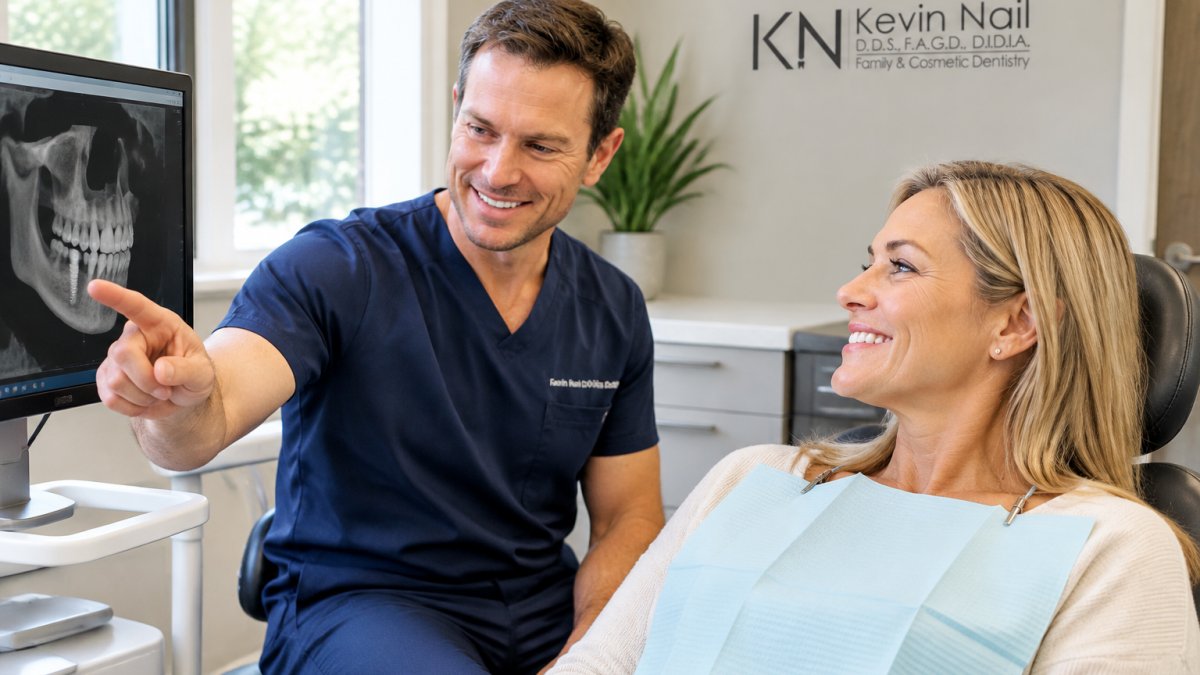
Postoperative discomfort varies between patients. Careful hygiene during healing remains important.
Our detailed flapless dental implant recovery timeline covers what to expect day by day and how to protect the site while the peri-implant tissue matures.
Who Is a Good Candidate for Flapless Implant Placement
The best candidates for flapless implant placement have adequate bone volume, a favorable alveolar ridge shape, and no need for simultaneous grafting. Good imaging is a prerequisite, not a bonus.
Candidacy is a clinical judgment, not a self-assessment. If you are weighing your options, our guidance on how to choose the right dental implant specialist covers the questions worth asking before committing to any surgeon.
Candidates for flapless placement are generally evaluated on factors such as ridge width and height on 3D imaging, smoking status, and systemic health. Individual candidacy is determined at consultation.
Contraindications are equally clear. Significant bone deficiency, active infection, uncontrolled systemic disease, and anatomy that cannot be safely imaged or guided all point toward a conventional approach instead.
Book a Flapless Implant Consultation with Dr. Kevin Nail
Deciding between techniques is easier with a real assessment than with a webpage. Because careful planning also means recognizing factors that can compromise an implant over time, Aviva Cosmetic Dentistry emphasizes the importance of understanding potential causes of failure and how to prevent them.
If you want to know whether your bone volume supports a minimally invasive approach, book a flapless implant consultation with Dr. Kevin Nail and get an answer based on your own imaging rather than a general statistic.
The gap between a survival figure and a genuinely successful outcome is where your decision actually lives. Call our team at 281-550-9054 to schedule an evaluation and review your imaging with Dr.
Frequently Asked Questions
What is the long-term success rate of flapless dental implants?
Survival and success outcomes for flapless dental implants vary across published studies, and definitions differ between them. Success rates, which also account for bone loss, soft-tissue health, and function, run somewhat lower than raw survival. Because definitions vary between studies, ask your dentist how they measure success and what follow-up period applies to your case.
Do flapless dental implants last as long as traditional implants?
The evidence comparing flap vs flapless implant surgery suggests long-term survival is similar when patients are appropriately selected and implants are well positioned. Flapless placement relies on accurate three-dimensional imaging and guided planning, so outcomes depend heavily on surgical accuracy. Maintenance, bone volume, and overall health influence longevity more than the flap decision alone.
What factors can cause a flapless dental implant to fail?
Common dental implant failure causes include poor bone volume, inaccurate implant positioning, infection, smoking, uncontrolled diabetes, and heavy bite forces. Flapless implant surgery risks also include limited direct visibility of the ridge, which is why CBCT scans and careful patient selection matter. Peri-implantitis and marginal bone loss are the main long-term threats, so regular hygiene visits are essential.
How does flapless implant surgery affect healing and recovery?
Flapless implant recovery time is often shorter than with flap elevation because there is no incision or suturing of the gum. Patients' experiences of postoperative swelling, bleeding, and discomfort vary. Healing still depends on bone quality, the number of implants placed, and how closely you follow aftercare instructions.