 how-to
How to Choose the Right Dental Implant Specialist
Table of Contents
- Start With Credentials: Dental Implant Specialist Qualifications That Matter
- Questions to Ask a Dental Implant Specialist Before You Commit
- Your Dental Implant Consultation Checklist: What to Bring and What to Expect
- Dental Implant Surgery Risks: What to Discuss Before Treatment
- Comparing Providers: Solo Practice, Multi-Doctor Office, or Specialist Referral
- Red Flags and Green Flags When Evaluating a Provider
- Conclusion
- Frequently Asked Questions
Last Updated: October 13, 2026
Start With Credentials: Dental Implant Specialist Qualifications That Matter
The right dental implant specialist combines a valid state license, implant-specific training, and enough surgical volume to stay sharp. A general dental license alone does not prove surgical skill.
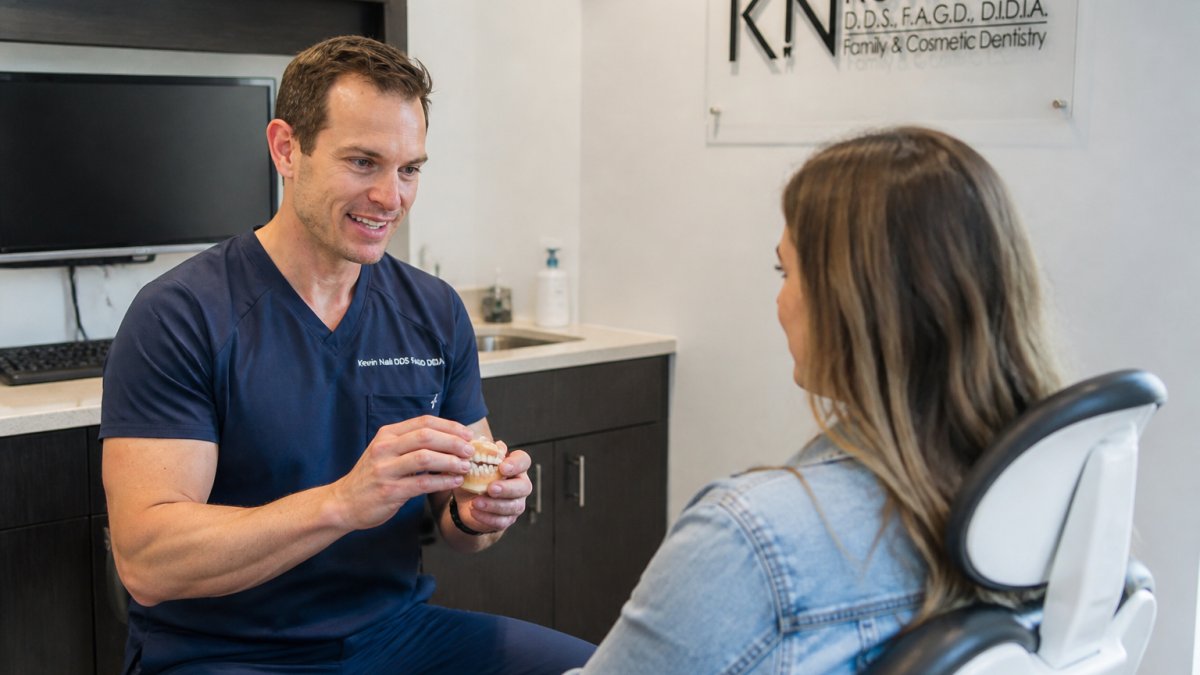
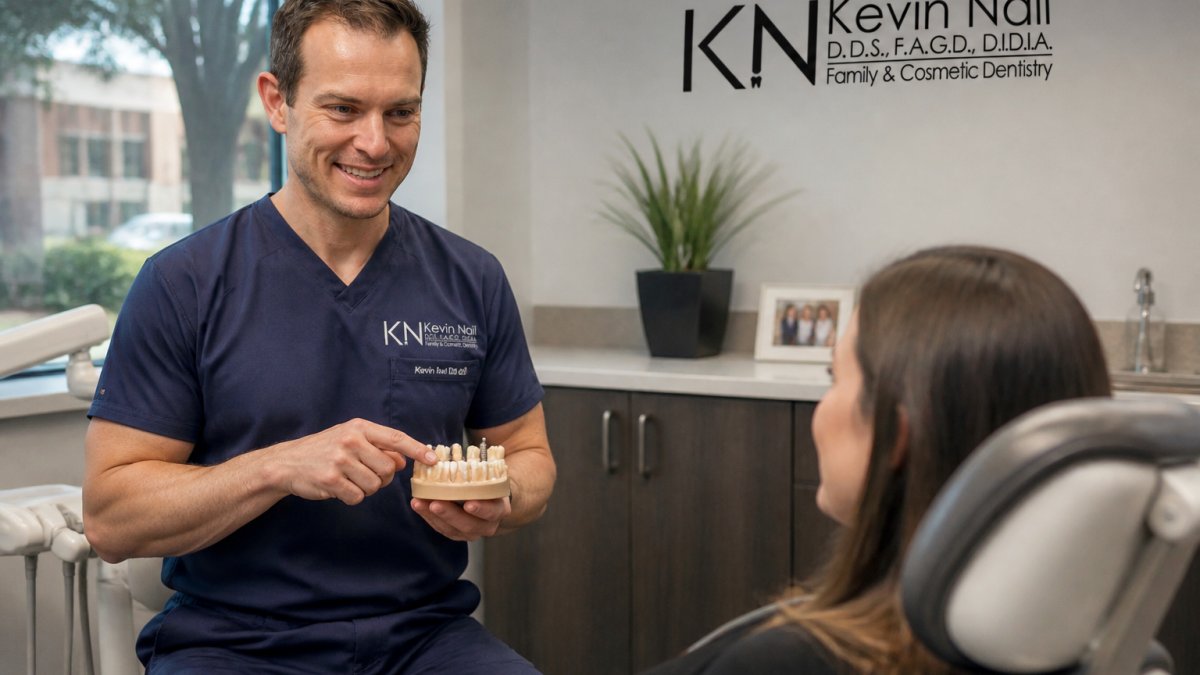
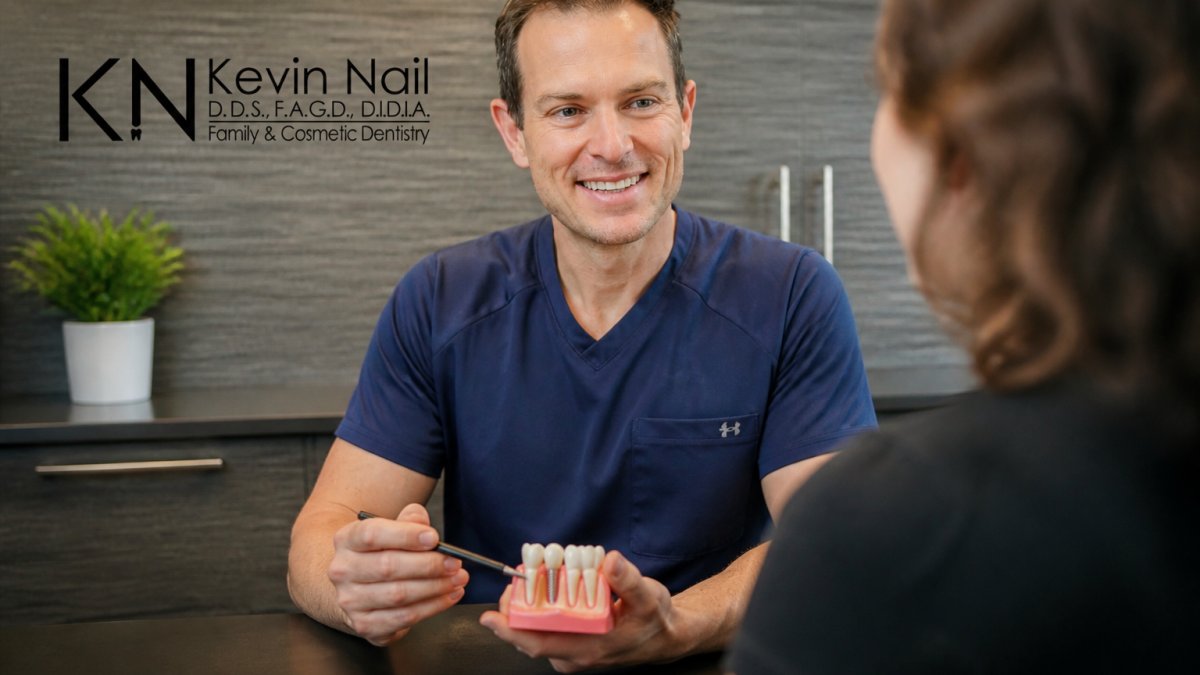
Dr. Kevin Nail of Kevin Nail DDS built his practice on verifiable credentials.
Licensure, Fellowships, and Implant-Specific Training
Look for training beyond dental school, since implant surgery is not standard in every program. Ask about:
- Fellowships in implant dentistry
- Membership in implant-focused organizations
- Hands-on surgical training hours
The American Dental Association's guidance on licensure explains what a license does and does not cover. It does not certify surgical implant skill on its own.
Experience Volume and Advanced Technique Training
Volume matters: a dentist who places implants weekly handles surprises better than one who places a few a year.
Ask how many implants they place each month. Ask what techniques they use. Minimally invasive methods, like flapless placement, often mean less swelling and faster recovery.
Questions to Ask a Dental Implant Specialist Before You Commit
A good consultation feels like a conversation, not a sales pitch. These questions separate a careful provider from a rushed one.
Treatment Planning, Technology, and Who Performs the Surgery
Ask who actually places the implant. Some offices plan the case but send you elsewhere for surgery.
Ask what imaging they use. A CBCT scan gives a three-dimensional view of your jaw, helping plan implant position, depth, and angle.
Ask about the plan itself. A clear provider explains:
- Where the implant goes and why
- How they protect nearby nerves and sinuses
- What happens if the plan changes mid-surgery
Aftercare, Emergency Access, and Cost Transparency
Ask what happens after surgery and who to call if something feels wrong. Before you commit, request a written estimate listing every part, implant, abutment, crown, and imaging, then ask how your insurance handles each line.
Your Dental Implant Consultation Checklist: What to Bring and What to Expect
A strong consultation is a two-way exchange. You bring your history; the provider brings a plan.
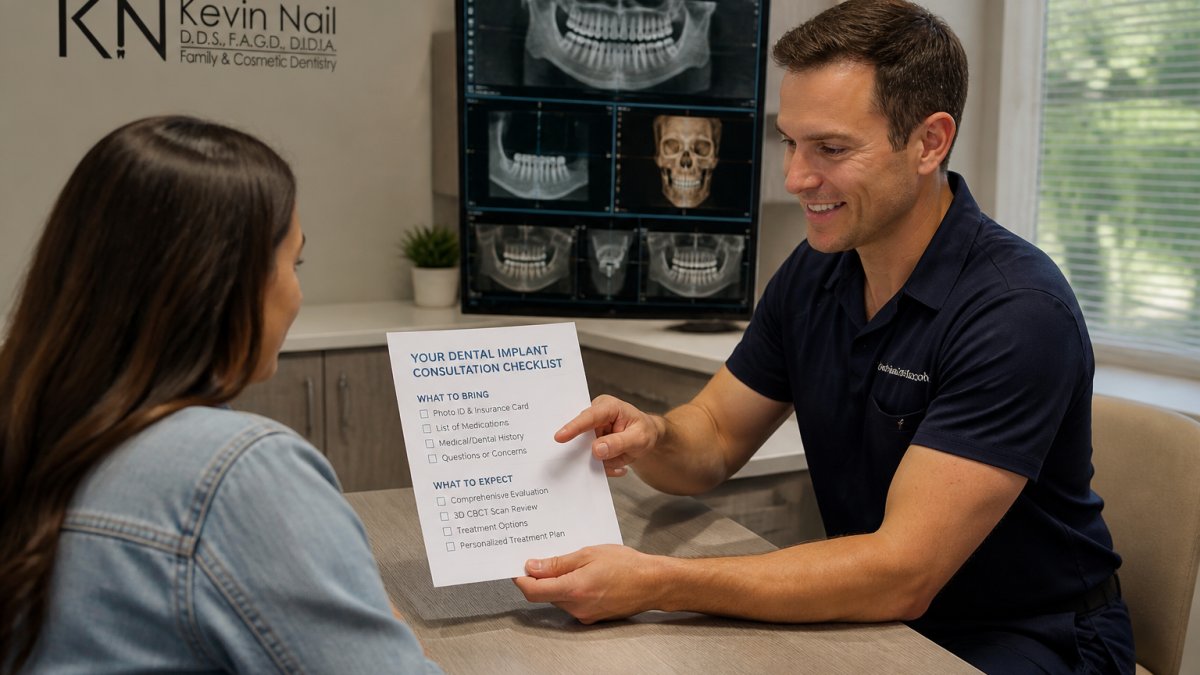
Bring these items to your visit:
- A list of all medications and supplements
- Your medical history, including diabetes or osteoporosis
- Prior dental records and X-rays, if you have them
Expect a full exam, imaging, and a risk discussion. A careful provider will not rush you into same-day surgery.
Dental Implant Surgery Risks: What to Discuss Before Treatment
Every implant procedure carries risk, and guided surgery does not change that, it changes where the risk sits. Separating surgical risks from planning, guide, and digital-transfer risks helps you ask better questions and give real informed consent.
Risks That Apply to Any Implant Procedure
These complications can occur whether the implant is placed freehand, with a static guide, or with dynamic navigation:
- Infection at the implant site. Usually manageable with antibiotics, but deep infection can threaten the restoration.
- Bleeding and swelling. Usually minor and resolved within days; prolonged bleeding or expanding swelling needs same-day attention.
- Nerve injury. The inferior alveolar nerve runs through the lower jaw and the lingual nerve near the tongue side of the mandible. Injury can cause numbness, tingling, or altered sensation in the lip, chin, gums, or tongue; most cases resolve over weeks to months, but a small share are permanent.
Risks Specific to Guided and Minimally Invasive Workflows
A surgical guide is a physical or digital tool built from your CBCT scan. It supports the planned position but does not guarantee it. Guide-related risks include:
- Guide fit and access problems. A guide depends on seating correctly on your teeth or bone. Limited mouth opening, a bulky guide, or an ill-fitting tray can prevent full seating and throw off the planned position.
- Accuracy limits and deviation. Every step, CBCT resolution, scan-to-guide conversion, manufacturing, seating, and drilling, introduces small deviations. A guide narrows the error band versus freehand placement but does not eliminate it; a millimeter or two can matter near a nerve or sinus floor.
- Plan changes during surgery. If the bone is softer than the scan suggested, a tooth is in the way, or the guide will not seat, the provider must adapt in real time. A rigid plan with no fallback is a red flag.
What to Do If the Guide Does Not Fit or the Plan Changes
This is the question most patients never ask, and it separates a prepared provider from an unprepared one. A reasonable pathway:
- Stop and reassess. Do not force a guide into place or keep drilling on a plan that no longer matches the anatomy.
- Re-image if needed. A new or updated CBCT can show whether bone, a tooth, or soft tissue is blocking the planned path.
- Choose a fallback. Options include converting to freehand or partially guided placement, adjusting implant position, using a different implant length or diameter, or closing the site and rescheduling after more planning.
- Document and explain. You should hear what changed, why, and what it means for healing, cost, and the final restoration.
Ask directly: What is your plan B if the guide does not seat or the bone does not match the scan? A vague answer is a signal.
How Risk Compares by Workflow
| Workflow | Main Advantage | Main Trade-Off |
|---|---|---|
| Freehand placement | Full visibility and tactile feedback; easy to adapt mid-surgery | Relies heavily on clinician skill and experience; higher variance in position |
| Static surgical guide | Transfers a pre-planned position to the mouth; good for straightforward and moderately complex cases | Depends on accurate seating; limited flexibility if the plan changes |
| Dynamic navigation | Real-time tracking with the ability to adjust during surgery | Requires line of sight to the tracking markers; equipment and training dependent |
No workflow is automatically safer. The right choice depends on your anatomy, the number and location of implants, the provider's experience with that workflow, and case complexity.
What the Evidence Actually Shows
Research on guided implant surgery generally supports better planned accuracy than freehand placement, especially for position, angulation, and depth. But the evidence has limits: study designs vary widely, many compare a single clinician or system rather than real-world mixed practice, complication rates differ by case complexity and definitions, and study-setting accuracy does not automatically translate to every clinical setting.
Questions to Ask Before You Consent
Bring these to your consultation and write down the answers:
- What did the CBCT show about my bone height, bone width, and nerve or sinus proximity?
- Which workflow do you recommend for my case, and why?
- How many implants have you placed using this specific workflow in the last year?
The U.S. Food and Drug Administration's information on dental implants is a useful starting point for understanding device safety and reporting. Use it alongside, not instead of, a direct conversation with your provider.
Comparing Providers: Solo Practice, Multi-Doctor Office, or Specialist Referral
The setting matters less than the fit between your case and the provider's training, volume, and workflow. A single-tooth implant in solid bone is a different problem from a full-arch reconstruction near the sinus or nerve, match the provider to the case, not the other way around.
What Each Setting Does Well
Solo practice. One clinician plans, places, and restores the implant.
Multi-doctor office. More scheduling flexibility and often more combined experience, but the risk is fragmentation: you may see one dentist for the consult, another for surgery, and a third for the crown.
Specialist referral. Periodontists, oral and maxillofacial surgeons, and prosthodontists often handle complex anatomy, grafting, or full-arch cases, while the restorative dentist places the crown.
Matching Case Complexity to Provider Type
| Case Type | Typical Fit | What to Verify |
|---|---|---|
| Single tooth, healthy bone, no grafting | Experienced general dentist or specialist | Recent volume with this exact workflow; CBCT-based planning |
| Multiple adjacent implants | General dentist with implant focus or specialist | Ability to manage spacing, angulation, and soft tissue |
| Upper back jaw near the sinus | Provider comfortable with sinus lift or referral | Sinus evaluation on CBCT; grafting experience |
| Lower jaw near the inferior alveolar nerve | Provider with nerve-safety planning experience | Documented approach to nerve proximity; contingency plan |
| Full-arch or full-mouth | Prosthodontist, surgeon, or a coordinated team | Who plans, who places, who restores, and how they communicate |
| Significant bone loss or prior failed implants | Specialist or referral | Grafting options, staged timeline, and realistic success expectations |
Credentials Worth Checking, and What They Do Not Prove
A state dental license is the legal floor; it does not certify surgical implant skill. Beyond it, look for:
- Fellowships and diplomate status in implant-focused organizations, which signal structured training and sometimes a case-review or examination process.
- Continuing education hours specific to implant surgery, not general dentistry.
- Recent case volume with the workflow being recommended for you.
Credentials are a starting filter, not a guarantee. The consultation itself, how the provider explains your anatomy, alternatives, and risks, tells you more than a wall of certificates.
The Referral Question
If your dentist refers you out, ask three things:
- Who places the implant, and who restores it? Get names, not just roles.
- How do the two offices share the plan? A shared CBCT, written surgical guide plan, and common record are good signs.
- Who owns follow-up? If something feels wrong two weeks after surgery, you should not be bounced between offices.
A clean referral is not a weakness. For complex cases, it is often the safer path.
At Kevin Nail DDS, Dr. Nail personally performs every procedure, keeping planning, surgery, and follow-up under one roof, one model, not the only one, worth weighing against referral options for your case.
Red Flags and Green Flags When Evaluating a Provider
Red flags:
- Pressure to schedule surgery the same day
- Vague answers about who performs the surgery
- No written cost estimate
Green flags:
- Clear answers about training and case volume
- A written treatment plan with risks explained
- A defined way to reach the office after surgery
Kevin Nail DDS holds a Fellowship in the Academy of General Dentistry and is a Diplomate of the International Dental Implant Association. Dr. Nail is also the first and only accredited AMII protocol trained dentist in Texas.
Conclusion
Choosing a dental implant specialist comes down to checking credentials, asking hard questions, and understanding the risks before you commit. A provider who welcomes those questions is usually the right one.
At Kevin Nail DDS, Dr. Our long-term staff knows patients by name, and we offer same-day emergency care.
Call 281-550-9054 to schedule your consultation and get a clear plan for your implant treatment.
Frequently Asked Questions
What qualifications should a dental implant specialist have?
Look for an active state dental license, a DDS or DMD degree, and post-graduate training specific to implant placement, such as a fellowship or residency. Memberships in organizations like the Academy of General Dentistry or the International Dental Implant Association signal peer-reviewed standards. Ask how many implants the dentist places per year and whether they have training in advanced techniques such as flapless or guided surgery. Verify credentials through your state dental board before scheduling a consultation.
What questions should I ask at a dental implant consultation?
Ask who will perform the surgery, how many implants they place annually, and what imaging they use for planning, such as a CBCT scan. Request a written treatment plan that lists the implant brand, the number of visits, and what happens if the implant fails. Ask about sedation options, aftercare instructions, and how to reach the office for urgent issues. Finally, request a cost breakdown in writing and confirm what your dental insurance covers before you commit.
What can go wrong with dental implant surgery?
Common risks include infection, swelling, bruising, and postoperative pain. More serious complications include nerve injury that can cause numbness or tingling in the lip, chin, or tongue; sinus injury when implants are placed in the upper jaw; and implant failure when the implant does not integrate with bone. Gum disease, diabetes, osteoporosis, and smoking can raise these risks. A thorough consultation, accurate imaging, and a clear aftercare plan help reduce the chance of complications.
How do I compare dental implant treatment plans from different providers?
Compare the number and type of implants proposed, the imaging used for planning, the implant brand, and whether the dentist performs the surgery personally. Ask each provider for a written plan that lists all visits, the total fee, and what is excluded. Check whether follow-up visits and any revision surgery are included. A lower upfront price may exclude imaging, sedation, or the final crown, so compare the full scope rather than the headline number.