 how-to
Benefits of Flapless Dental Implants Explained
Table of Contents
- What Flapless Dental Implants Actually Are
- Flapless vs. Traditional Flap Surgery: Key Differences
- Primary Benefits of Flapless Dental Implants
- Flapless Dental Implant Recovery Time: What to Expect
- Minimally Invasive Dental Implant Surgery: The Digital Workflow
- Dental Implant Procedure Steps for a Flapless Placement
- Who Is a Good Candidate, and Who Is Not
- Cost Considerations and What to Ask Your Dentist
Last Updated: August 26, 2026
What Flapless Dental Implants Actually Are
Flapless dental implant surgery is a minimally invasive technique in which an implant is placed through a small tissue punch in the gum, bypassing the traditional incision and flap reflection entirely. The implant goes in through a precisely sized opening, and the surrounding gingival tissue stays intact.
At Kevin Nail DDS, this technique relies on advanced 3D imaging and a surgical template to guide the implant to its exact position without disturbing the tissue architecture. Traditional flap surgery involves making incisions along the gumline, lifting the tissue back to expose bone, placing the implant, then suturing everything closed. Flapless surgery eliminates most of those steps, reducing surgical trauma, preserving vascular supply, and shortening recovery.
Clinical literature confirms that when patient selection is appropriate and imaging is thorough, flapless placement can match or closely approach the osseointegration outcomes of traditional surgery, with meaningful advantages in recovery and tissue preservation. However, "flapless" does not mean "unguided." The technique depends entirely on precision. Without accurate anatomical data, placing an implant without direct visual access to the bone is reckless. The procedure works because of what happens before the patient sits in the chair.
Flapless vs. Traditional Flap Surgery: Key Differences
Flap surgery gives the surgeon direct visual and tactile access to the bone, which is useful in complex cases with irregular bone volume or poor bone density. The tradeoff is tissue disruption: reflecting a flap severs blood vessels in the periosteum, slows healing, increases postoperative swelling, and requires sutures that must be removed at a follow-up visit.
Flapless surgery preserves the periosteum and the vascular supply beneath it. Bone remodeling after implant placement is partly governed by how well that blood supply is maintained. Flapless procedures are also typically faster because there is no flap to raise and close, which benefits patients under sedation.
Comparison Table: Flapless vs. Flapped Implant Surgery
| Factor | Flapless Surgery | Traditional Flap Surgery |
|---|---|---|
| Incision size | Small tissue punch only | Full incision along gumline |
| Soft tissue disruption | Minimal | Significant flap reflection |
| Suturing required | Rarely | Almost always |
| Postoperative swelling | Typically reduced | More common and pronounced |
| Surgical time | Shorter | Longer |
| Recovery period | Generally faster | Typically longer |
| Bone visibility | Relies on CBCT imaging | Direct visual access |
| Best for | Adequate bone, good imaging | Complex anatomy, limited imaging |
| Immediate loading potential | Often compatible | Case-dependent |
Individual outcomes depend on bone density, anatomical landmarks, overall health, and the surgeon's experience with each technique. A thorough consultation and CBCT scan are required to determine which approach is appropriate.
Primary Benefits of Flapless Dental Implants
The benefits of flapless dental implants follow directly from the biology of avoiding unnecessary tissue cutting.
Reduced postoperative swelling and discomfort result because the periosteum and surrounding soft tissue are not reflected or sutured. Preservation of soft-tissue architecture, including the peri-implant papillae that fill spaces between teeth, maintains long-term aesthetics. Maintained vascular supply to the bone supports healthy bone remodeling. Shorter surgical time matters for patients with anxiety or those receiving sedation. Faster return to normal activity follows the reduced healing time, with reduced bleeding and lower infection risk from the smaller wound.
Reduced Postoperative Swelling and Discomfort
The most immediate benefit patients notice after flapless implant surgery is how little it feels like surgery. Postoperative swelling after traditional flap surgery can persist for days and affect speech and eating. With flapless placement, the tissue punch is small, the surrounding gingival tissue is undisturbed, and there are no sutures pulling against healing tissue. Many patients report minimal swelling and manage with over-the-counter pain relief rather than prescription medications.
This results directly from reduced surgical trauma. When you do not cut, peel back, and re-suture a flap, you do not trigger the same inflammatory cascade. For patients who have had traditional implant surgery elsewhere and experienced significant postoperative discomfort, the difference with a flapless approach can be striking.
Preservation of Soft-Tissue Architecture and Peri-Implant Papillae
The peri-implant papillae are the small triangular projections of gum tissue that fill spaces between teeth and implants. They determine whether your final restoration looks natural or clinical. Once lost due to mucosal recession or surgical disruption, rebuilding them is difficult and often incomplete.
Flapless surgery preserves these structures by leaving the surrounding tissue intact. There is no flap reflection, no disruption to interdental tissue, and no suturing that can cause scarring or retraction. As documented in clinical guidance from the American Academy of Periodontology, peri-implant tissue health is a primary determinant of long-term implant success.
Long-Term Aesthetic Outcomes
Mucosal recession around implants is one of the most common aesthetic complications in implant dentistry, exposing the implant collar and creating visible dark margins. The risk of recession is higher when soft tissue has been surgically disrupted. Flapless placement, by preserving the tissue envelope, reduces this risk. Patients who receive flapless implants with appropriate bone volume tend to maintain more stable gingival margins over time, with the final crown emerging naturally from the gum. This long-term stability makes the flapless approach particularly well-suited to visible areas of the mouth, especially anterior teeth.
Flapless Dental Implant Recovery Time: What to Expect
Flapless dental implant recovery time is shorter than traditional implant surgery for most patients. Most report mild discomfort and minimal swelling in the first 24-48 hours, with many returning to normal eating and daily activities by day three to five. Compare that to traditional flap surgery, where swelling may peak around day two or three and significant discomfort can persist for a week or more. The absence of sutures removes one source of ongoing irritation.
Recovery timeline:
- Day 1-2: Rest recommended. Soft foods only. Minimal swelling and bleeding typical.
- Day 3-5: Most patients feel significantly better. Swelling resolves faster than with flap surgery.
- Week 1-2: Normal activity for most patients. Avoid hard or crunchy foods near the implant site.
- Weeks 4-12: Osseointegration continues. The implant fuses to the surrounding bone.
- 3-6 months: Final restoration placed once osseointegration is confirmed.
The osseointegration timeline is not shortened by the flapless approach. What changes is the soft-tissue healing phase, which is faster and more comfortable.
Minimally Invasive Dental Implant Surgery: The Digital Workflow
Minimally invasive dental implant surgery, done correctly, is a pre-surgical procedure as much as a surgical one. The majority of planning happens before the patient sits in the chair.
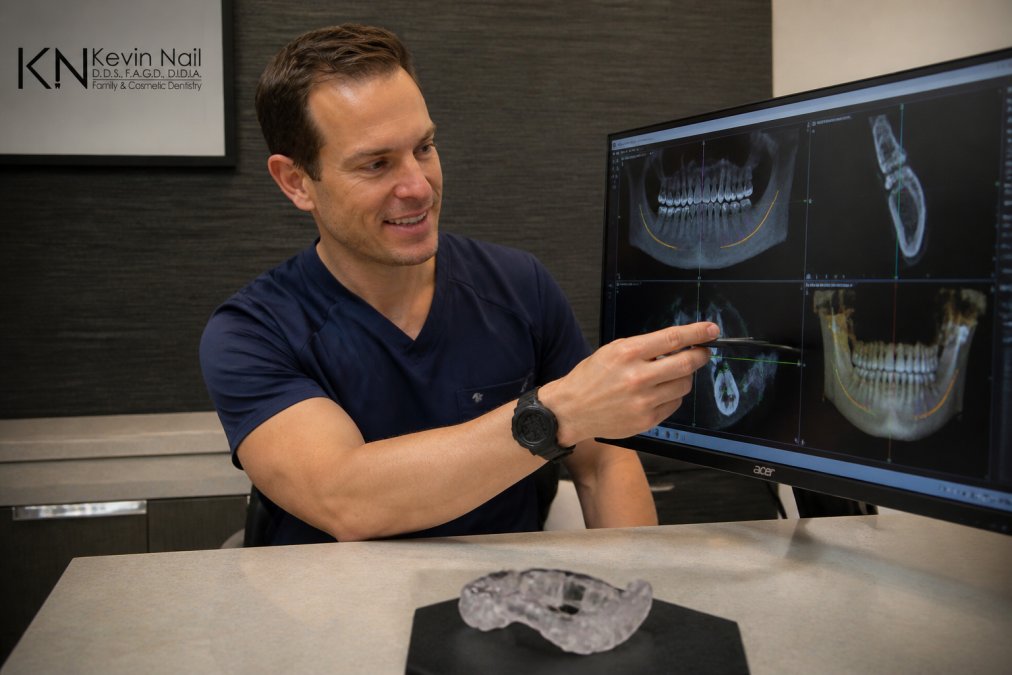
The process begins with a cone beam CT scan. CBCT imaging produces a three-dimensional map of the patient's jawbone, showing bone density, bone height, nerve location, sinus proximity, and every anatomical landmark that matters for safe implant placement. According to the American Dental Association's guidance on CBCT imaging, this technology gives clinicians sub-millimeter precision that two-dimensional X-rays cannot provide.
That CBCT data is imported into implant planning software. The surgeon identifies the optimal implant position, angle, and depth virtually, accounting for the final restoration's position and aesthetic outcome. Once the plan is finalized, a surgical template is fabricated. This template fits over the patient's teeth and guides the drill to exactly the planned position, depth, and angle.
When the surgeon places the tissue punch and inserts the implant, they are executing a plan already validated digitally. Dr. Nail's training as the first and only accredited AMII protocol-trained dentist in Texas reflects this integration of digital planning and minimally invasive execution.
Dental Implant Procedure Steps for a Flapless Placement
Step 1: Comprehensive Examination and Imaging A full clinical examination is combined with CBCT imaging to assess bone volume, bone density, gingival health, and anatomical landmarks. This determines whether flapless placement is appropriate.
Step 2: Digital Treatment Planning The CBCT data is used to plan the implant position virtually. The surgeon selects implant dimensions, angle, and depth, identifying potential complications before any drilling begins.
Step 3: Surgical Template Fabrication A custom surgical template is made from the digital plan, fitting over existing teeth to guide instruments to the exact planned position.
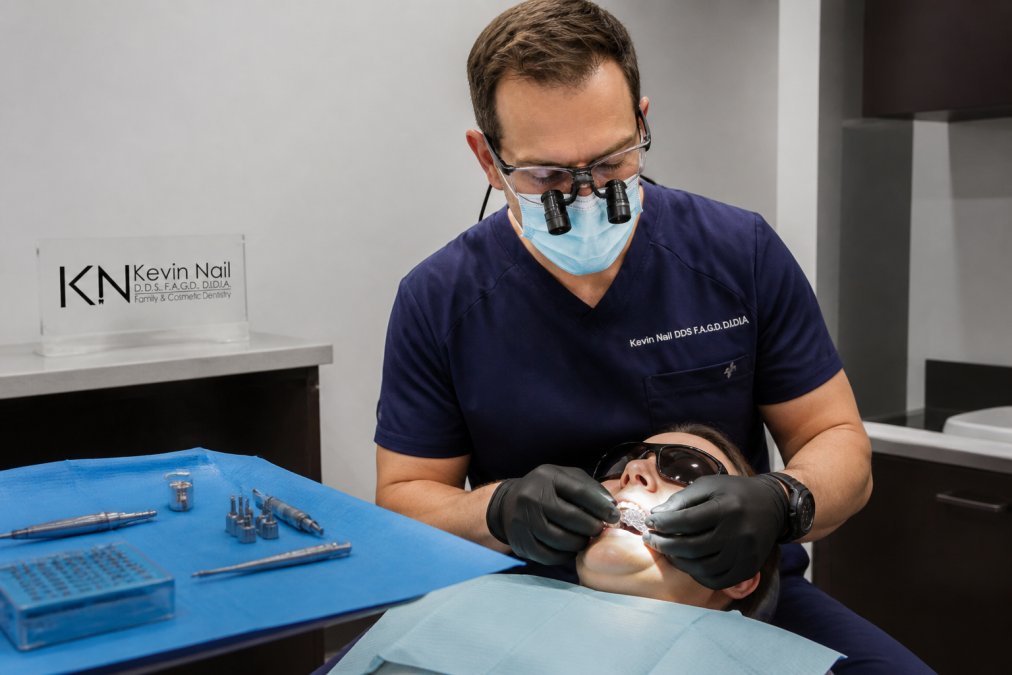
Step 4: Implant Placement A small tissue punch removes a circular piece of gum tissue. The surgical template is seated, the osteotomy is prepared through the template, and the implant is inserted. No incisions, no flap, no sutures in most cases.
Step 5: Healing and Osseointegration The implant integrates with surrounding bone over 3-6 months. A healing cap or temporary restoration protects the site.
Step 6: Final Restoration Once osseointegration is confirmed, the final crown is fabricated and placed.
The entire process from consultation to final crown typically spans several months, though the active surgical time is a fraction of that.
Who Is a Good Candidate, and Who Is Not
The flapless technique is not appropriate for every patient.
Good candidates for flapless implant surgery generally have:
- Adequate bone volume and density at the implant site, confirmed by CBCT
- Healthy gingival tissue without significant recession or infection
- No active periodontal disease
- Sufficient keratinized gum tissue around the planned implant site
- Anatomical landmarks clearly identified and safely distant from the planned implant position
Patients for whom traditional flap surgery may be more appropriate include:
- Those with insufficient bone requiring simultaneous grafting
- Cases with active infection or significant bone defects needing direct visualization
- Situations where CBCT data is ambiguous or anatomical landmarks are too close to the planned implant position
- Patients with limited mouth opening that makes accurate template placement difficult
Some cases simply need a flap. Attempting flapless placement in inappropriate candidates produces complications rather than benefits. A thorough CBCT evaluation and honest assessment of the imaging should guide the decision, not patient preference alone. According to implant dentistry clinical guidelines from the International Congress of Oral Implantologists, patient selection criteria for flapless surgery should be strictly applied.
Cost Considerations and What to Ask Your Dentist
Flapless implant surgery often involves additional planning costs compared to traditional placement because of CBCT imaging and surgical template fabrication. However, shorter surgical time, no suture removal appointment, and faster recovery all have real value.
For cost specifics at Kevin Nail DDS, call 281-550-9054 and schedule a consultation. Treatment costs vary based on the number of implants, the need for bone grafting, the type of final restoration, and insurance coverage. PPO insurance plans sometimes provide partial coverage for implant procedures, though specifics depend entirely on your individual plan.
Questions worth asking before committing to any implant provider:
- Will a CBCT scan be taken before surgery? If the answer is no, ask why.
- Will a surgical template be used? Flapless placement without a template is not truly guided surgery.
- What is your experience with flapless placement specifically? Volume and training matter.
- Is immediate loading an option in my case? Not always appropriate, but worth discussing.
- What does the fee include? Clarify whether imaging, the template, the implant, and the crown are bundled or billed separately.
The cost-benefit calculation ultimately comes down to recovery. A procedure with less postoperative swelling, faster healing, and lower risk of soft-tissue complications is worth understanding fully before choosing based on price alone. For patients with dental anxiety, the shorter chair time and reduced postoperative experience of flapless surgery may be the deciding factor.
Choosing an implant provider is one of the more consequential dental decisions a patient makes. The technique matters, but so does the person performing it. Dr. Kevin Nail is the first and only AMII protocol-accredited dentist in Texas, a Diplomate of the International Dental Implant Association, and a featured lecturer for the Academy of Minimally Invasive Implant Dentistry. Every procedure at Kevin Nail DDS is performed personally by Dr. Nail, using CBCT imaging and surgical templates designed for sub-millimeter precision. If you are ready to find out whether flapless implant surgery is right for you, call 281-550-9054 to schedule a consultation.
Frequently Asked Questions
What are the primary benefits of flapless dental implants?
Flapless dental implants preserve the surrounding soft tissue and vascular supply by eliminating the need to cut and reflect a flap of gum tissue. This results in less surgical trauma, reduced postoperative swelling and discomfort, faster healing time, and better preservation of the peri-implant papillae, the small triangles of gum between teeth that define a natural-looking smile. Because no suturing is required, patients typically return to normal activity much sooner than with traditional flap surgery.
What is the recovery time for flapless dental implants?
Flapless dental implant recovery time is generally shorter than traditional surgery. Most patients experience minimal swelling and discomfort in the first 24 to 72 hours, and many return to work or normal routines within a day or two. Full osseointegration, the process where the implant fuses with the jawbone, still takes several months regardless of technique. Individual healing depends on bone density, overall health, and how closely post-procedure instructions are followed.
Is flapless dental implant surgery less painful than traditional methods?
Most patients report noticeably less discomfort after flapless implant placement compared to traditional flap surgery. Because the gum tissue is not cut open and reflected, there is less tissue disruption and no sutures to irritate the area during healing. Postoperative swelling and bleeding are also typically reduced. That said, every patient's experience differs, and a thorough consultation is the best way to understand what to expect based on your specific anatomy and health history.
Are there patients who are not good candidates for flapless implant surgery?
Flapless implant surgery requires sufficient bone volume and density, since the surgeon cannot directly visualize the surgical site during placement. Patients with significant bone loss, irregular bone contours, or inadequate gum tissue thickness may need traditional flap surgery instead. Accurate 3D CBCT imaging and careful treatment planning are essential for determining candidacy. A qualified implant dentist will review your scans and medical history before recommending which approach is appropriate for your situation.
This article was written using GrandRanker