 blog
blog
Dental Office Houston: What to Expect
Table of Contents
- What Makes a Quality Dental Office Houston
- Family Dentistry Services Under One Roof
- Cosmetic Dentistry Options for Your Smile
- Dental Implant Surgery Recovery and Care
- Managing Dental Anxiety in Your Dental Office
- Emergency Dental Care When You Need It
- Insurance, Financing, and Transparent Pricing
- Frequently Asked Questions
Last Updated: September 20, 2026
What Makes a Quality Dental Office Houston
When you're choosing a dental office, you're not just picking a place to get your teeth cleaned. You're selecting a partner for your oral health. A quality dental office Houston should offer comprehensive dental care, preventative dentistry, and the ability to handle everything from routine check-ups to complex restorative procedures under one roof.

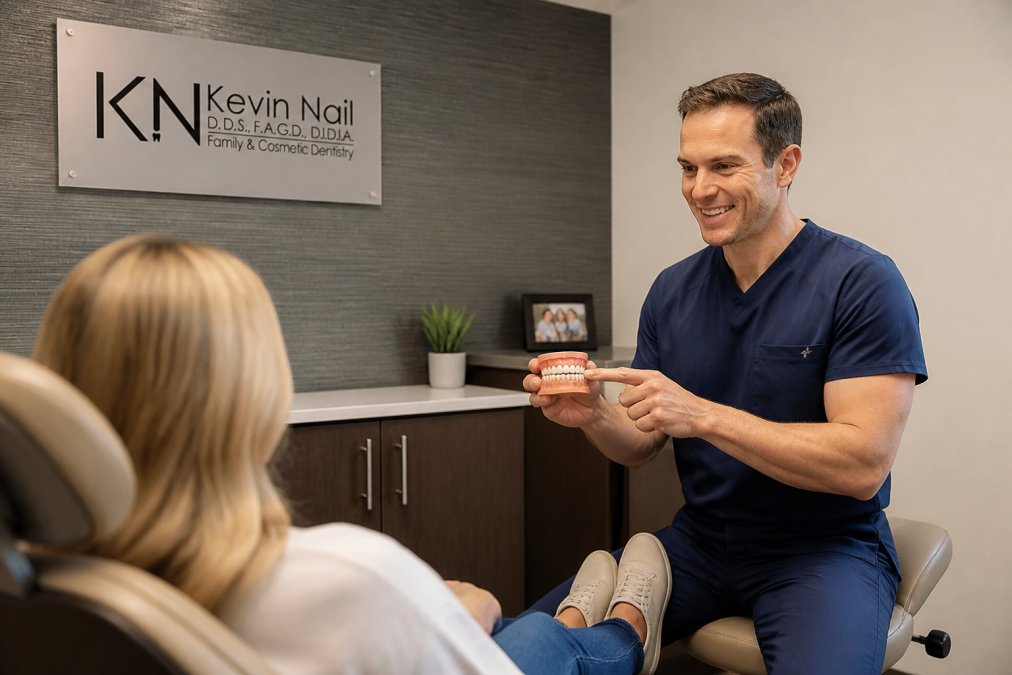
The best dental practices combine clinical expertise with genuine patient comfort. This means experienced dentists who stay current with advanced techniques, long-term staff who remember your name and history, and an environment designed to ease dental anxiety rather than amplify it. At Kevin Nail DDS, every procedure is personally performed by Dr. Nail himself, eliminating the inconsistency that comes from rotating providers. His advanced training in minimally invasive implant dentistry, he's the first and only AMII protocol-trained dentist in Texas, means you're getting precision.
Look for a dental office Houston that uses modern diagnostic tools like 3D cone beam CT scans for sub-millimeter accuracy. This technology transforms treatment planning from guesswork into science. The difference shows up in your recovery time, comfort level, and long-term outcomes.
Family Dentistry Services Under One Roof
Families shouldn't need three different dentists. One office should handle pediatric dentistry for your kids, general dentistry for routine care, and restorative procedures for the adults. This consolidated approach means your entire family's oral health records exist in one place, your kids see a familiar face instead of rotating providers, and you spend less time coordinating appointments across town.
A quality family dental office Houston provides dental hygiene education for all ages, routine check-ups and dental cleaning services, and digital imaging that lets you see exactly what's happening in your mouth.
The convenience is real, but the clinical benefit matters more. A dentist who knows your family's history, your kids' eruption patterns, your wife's previous crown work, your own gum health trajectory, makes better decisions than someone seeing you for the first time. That continuity of care prevents small problems from becoming expensive ones.
Cosmetic Dentistry Options for Your Smile
Cosmetic dentistry is no longer about fake-looking transformations. Modern techniques create natural results that enhance your smile without announcing themselves. A quality dental office Houston should offer porcelain veneers, teeth whitening, dental bonding, and smile design consultation, all performed with an eye toward proportion and your natural features.
The difference between good cosmetic work and mediocre work comes down to artistry combined with technical skill. Veneers that match your tooth color and blend seamlessly with your natural teeth require someone who understands light reflection, tooth anatomy, and aesthetics. Teeth whitening that brightens without damaging enamel requires knowledge of the chemistry involved. Bonding that lasts requires understanding material science and proper technique.
Many patients worry that cosmetic work will look artificial. That fear is justified when the dentist prioritizes transformation over harmony. The best cosmetic dentists ask what you want to change and what you want to keep. They show you mockups before committing to irreversible procedures. They understand that your smile should look like an improved version of you, not a completely different person.
Clear aligners have transformed orthodontics for adults. Unlike traditional braces, they're nearly invisible and removable.
Dental Implant Surgery Recovery and Care
Dental implants are the closest thing to replacing a natural tooth. An implant replaces the root, a crown replaces the visible part, and the result functions like your original tooth. But implant surgery recovery matters enormously, and this is where minimally invasive technique changes everything.
Traditional implant surgery involves cutting and peeling back your gum tissue, drilling into bone, and then suturing everything back together. Recovery means swelling, bleeding, discomfort, and typically 7-10 days before you feel normal. Minimally invasive flapless implant surgery eliminates the gum flap entirely. A small precision opening is made, the implant is placed, and you're done. The result: minimal swelling, minimal bleeding, and the ability to return to normal activity within days instead of weeks.
This isn't marketing language. The clinical difference is measurable. Flapless technique reduces post-operative swelling and bleeding, preserves more of your natural bone structure, and means less tissue trauma overall. If you've had implants before and experienced significant recovery time, flapless surgery feels like a different procedure entirely.
Post-procedure care is straightforward: avoid hard foods for a few weeks, maintain oral hygiene carefully, and attend your follow-up appointments. Your dental office Houston should provide clear written instructions and be available if complications arise. The implant itself requires no special maintenance.
Managing Dental Anxiety in Your Dental Office
Dental anxiety is real, and it's common. Some people fear pain, others fear loss of control, and others have had traumatic experiences. A quality dental office Houston acknowledges this and offers solutions rather than dismissing your concerns.
Sedation dentistry allows anxious patients to undergo necessary procedures while relaxed. The key is finding a dental office Houston with experience managing anxious patients safely.
Safety in sedation dentistry comes from proper training, appropriate monitoring equipment, and clear protocols. Your dentist should explain what to expect, discuss your anxiety history, and answer your questions before the procedure. You should understand what level of sedation is being used and why.
Beyond sedation, anxiety management starts with communication. A dentist who explains each step, shows you the tools beforehand, and gives you a hand signal to pause the procedure helps you feel in control. Long-term staff who remember your anxiety and adjust their approach accordingly make a difference. The environment itself matters, soft lighting, calm music, and comfortable seating reduce stress before the procedure even begins.
Many anxious patients delay necessary dental work for years, which makes problems worse. Addressing anxiety head-on means you can get preventative care, catch problems early, and avoid emergency situations. Your dental office Houston should treat anxiety as a legitimate clinical concern, not a character flaw.
Emergency Dental Care When You Need It
Dental emergencies don't wait for business hours. A cracked tooth, severe pain, or an infection can strike on a weekend or at night. A quality dental office Houston offers same-day emergency care or clear guidance on what to do until you can be seen.
Emergency dental services might include treating acute infections, managing severe pain, stabilizing a broken tooth, or addressing a knocked-out tooth. The goal is to relieve your immediate problem and create a plan for definitive treatment. Some emergencies require urgent intervention (like an infection spreading to surrounding tissue), while others can wait a few days for a comprehensive treatment plan.
The challenge with emergency care is availability. Some offices claim to offer it but require you to call an answering service and wait for a callback. Others have dedicated emergency time built into their schedule. The best dental offices Houston have the flexibility to work you in the same day when you're in genuine pain or facing a serious problem.
What constitutes a true emergency?
Insurance, Financing, and Transparent Pricing
One of the biggest barriers to dental care is uncertainty about cost. You don't want to discover mid-procedure that your insurance won't cover what you expected, or that you're facing a bill you can't afford. A quality dental office Houston is transparent about pricing and insurance coverage upfront.
| Service Type | Coverage Typical | Timing | Notes |
|---|---|---|---|
| Preventative (cleanings, exams) | 100% | Twice yearly | Usually no deductible |
| Basic restorative (fillings) | 80% | As needed | After deductible applies |
| Major restorative (crowns, bridges) | 50% | As needed | Often subject to annual max |
| Implants | 0-50% | Varies | Often considered major or cosmetic |
| Orthodontics | 50% | 24 months | Limited lifetime benefit |
| Cosmetic (whitening, veneers) | 0% | As desired | Never covered by insurance |
Frequently Asked Questions
What should I look for when choosing a dental office?
Look for a practice where the dentist personally performs procedures, staff members have long tenure with the practice, and the office offers comprehensive services including preventative dentistry, restorative procedures, and emergency care. Verify credentials through the Academy of General Dentistry or similar professional organizations. Ask about the technology they use, such as digital imaging and 3D cone beam CT scans, which enable more precise diagnostics and treatment planning.
How does minimally invasive implant dentistry reduce recovery time?
Minimally invasive techniques like flapless implant surgery avoid large incisions in the gum tissue, which reduces post-operative swelling, bleeding, and overall recovery time. Patients can typically return to normal activities much faster than with traditional surgical methods. This approach requires advanced training and precision imaging, such as 3D cone beam CT scans, to place implants accurately without extensive soft tissue disruption.
Will my PPO insurance cover dental implants and restorative work?
Coverage varies by individual plan. Most PPO plans cover routine preventative care like cleanings and exams at a higher percentage, while restorative procedures like implants may have lower coverage or annual maximums. Contact your insurance provider directly to understand your specific benefits, deductibles, and out-of-pocket costs. Your dental office should be able to verify your coverage and discuss financing options if insurance doesn't cover the full cost.
Is sedation dentistry safe for patients with anxiety?
Sedation dentistry, when administered by a trained and experienced dentist, is a safe option for anxious patients. The dentist monitors vital signs throughout the procedure and uses appropriate sedation levels for your comfort and the specific treatment. Discuss your anxiety history and any health concerns during your consultation so the dentist can recommend the safest sedation approach for you and explain what to expect before, during, and after the procedure.