 ultimate-guide
Family Dental Care Under One Roof: A Complete Guide
Table of Contents
- Why Family Dental Care Under One Roof Matters
- Comprehensive Dental Services for All Ages
- Benefits of Multi-Specialty Dental Practice
- How to Prepare Your Child for Their First Dental Visit
- Emergency Care and Same-Day Appointments
- Insurance, Financing, and Cost Transparency
- The Referral-Free Workflow and Coordinated Care
- Building Your Family's Long-Term Oral Health Roadmap
- Frequently Asked Questions
Last Updated: September 27, 2026
Why Family Dental Care Under One Roof Matters
Coordinating dental care for your entire family across multiple providers creates unnecessary friction. You're managing separate appointment schedules, duplicating health histories, and watching different practitioners make treatment decisions without seeing the full clinical picture. Family dental care under one roof eliminates that fragmentation. When one dentist knows your family's complete oral health history, coordinates preventive care for children while handling restorative work for adults, and manages cosmetic enhancements alongside emergency situations, treatment becomes more efficient and outcomes improve. (Source: Baby Teeth | MouthHealthy)
At Kevin Nail DDS, we've built our practice around this principle: comprehensive family dentistry in a single location where you see the same experienced doctor and familiar staff members every visit. This approach transforms how families experience dental health. Instead of scheduling three different offices for three different family members, you consolidate into one relationship with one practitioner who understands each person's unique needs, anxiety levels, and long-term oral health goals.
Comprehensive Dental Services for All Ages
True family dental care means having access to pediatric dentistry, adult preventive and restorative treatments, cosmetic enhancements, and emergency services all under one roof. This isn't about one dentist doing everything equally well, it's about one dentist offering genuine expertise across age groups and treatment categories, with the clinical depth to handle complex cases.
Pediatric Dentistry and Early Prevention
Children's teeth require a different approach than adult dentistry. Primary teeth guide the eruption of permanent teeth, so protecting them matters enormously (Baby Teeth | MouthHealthy). Early prevention through fluoride application, sealants, and behavioral guidance establishes habits that carry into adulthood. When a pediatric dentist tracks a child through their teenage years, they catch developing problems early, before they become expensive orthodontic cases later.
A child's first dental visit sets the tone for their entire relationship with dentistry. A calm environment, predictable routines, and a dentist who explains procedures in age-appropriate language transform what could be an anxiety-inducing experience into something manageable. Many children who develop dental phobia do so because their first experience felt rushed, unexplained, or overwhelming. The opposite is true when a pediatric dentist takes time to build trust, let the child explore the operatory, and explain what's happening in simple terms.
Adult Restorative and Cosmetic Options
Adult patients need dentists who can handle the full spectrum of restorative work: fillings, crowns, bridges, root canals, and implants. Cosmetic dentistry, veneers, bonding, teeth whitening, clear aligners, has become central to how adults think about their smiles. The ability to address both function and aesthetics matters. A tooth that's been restored should look natural and feel strong. A smile transformation should enhance your appearance without looking overdone or artificial.
Minimally invasive implant dentistry represents the current standard of care for tooth replacement. Rather than traditional surgical approaches that require cutting and lifting gum tissue, flapless implant placement uses advanced imaging and precision drilling to place implants with less trauma. This means reduced post-operative swelling, less bleeding, and faster recovery. Patients can return to normal activities within days rather than weeks.
Benefits of Multi-Specialty Dental Practice
The advantages of consolidating care extend beyond convenience. When one dentist manages your family's oral health, treatment planning becomes coordinated. If your child needs orthodontics, your spouse needs implants, and you need cosmetic work, a multi-specialty dentist can see how these treatments interact. Bite alignment affects how implants function. Cosmetic work should complement orthodontic outcomes. A dentist who manages the whole family avoids the fragmented decision-making that happens when specialists don't communicate.
Clinical continuity also improves outcomes. Your dentist knows your gag reflex sensitivity, your anxiety triggers, your healing patterns, and your preferences about treatment. They don't need to re-explain your history or re-take baseline X-rays every visit. This familiarity reduces appointment time and increases comfort.
Emergency dental problems don't follow business hours. When you have an established relationship with one practice, same-day emergency care becomes possible. A dentist who knows you can often fit you in quickly because they understand your history and can work efficiently. Waiting weeks for an emergency appointment at an unfamiliar practice is both painful and risky.
How to Prepare Your Child for Their First Dental Visit
A child's first dental visit should feel like an introduction, not an interrogation. The goal is to familiarize them with the environment, the sounds, and the people, not to perform extensive treatment. Most dentists recommend scheduling this visit within six months of the first tooth erupting.
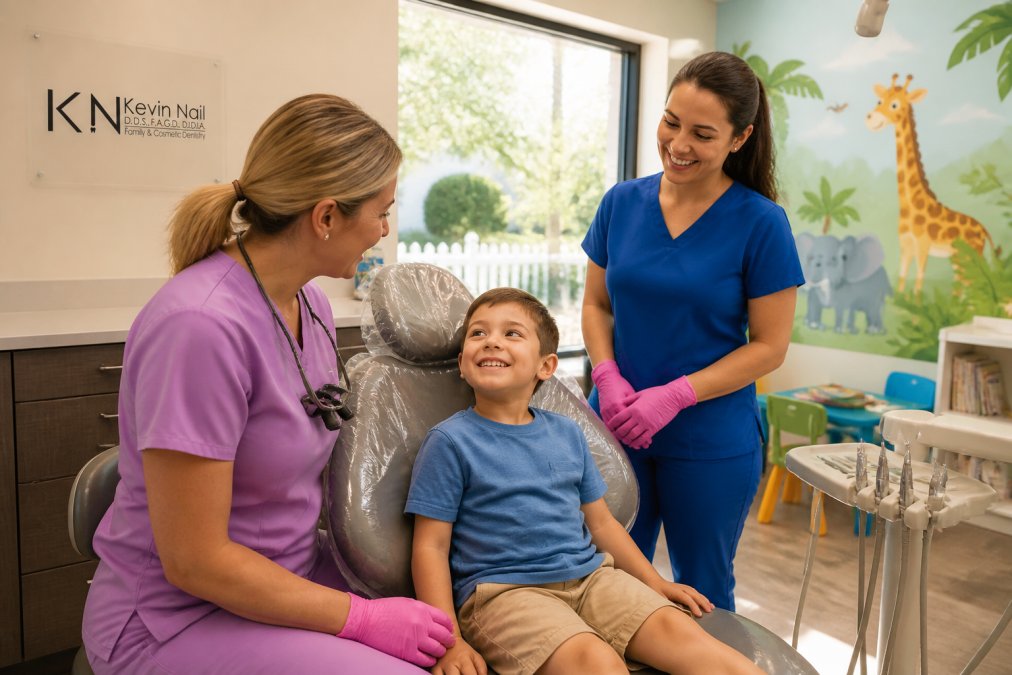
Before the appointment, talk to your child about what to expect in simple, positive language. Avoid words like "shot," "pain," or "drill", these create anxiety. Instead, explain that the dentist will look at their teeth, count them, and maybe clean them with a special tool that makes a buzzing sound. Let them know the dentist and hygienist are friendly people who help keep teeth healthy and strong.
On the day of the appointment, stay calm and positive. Children pick up on parental anxiety. If you're nervous about dental visits, don't project that onto your child. Arrive early so they can acclimate to the waiting room. Many pediatric offices let children play with toys or watch a short video to settle in.
During the visit, let the dentist lead. Sit where your child can see you but where you're not hovering. A good pediatric dentist will explain each step, show your child the tools, and let them hold or touch instruments before they're used. This builds trust and reduces fear.
After the visit, praise their cooperation regardless of how it went. Positive reinforcement matters. If they were anxious, acknowledge that without making it a big deal. The next visit will be easier because they know what to expect.
Emergency Care and Same-Day Appointments
Dental emergencies happen: a child falls and chips a tooth, an adult develops sudden pain from a cracked molar, an infection causes swelling. When you have an established relationship with a practice, emergency care becomes accessible. A dentist who knows you can often fit you in the same day because they understand your situation and can work efficiently without the time investment of a new patient evaluation.
Same-day appointments for non-emergency issues also matter. A child develops a cavity and needs it addressed before it worsens. You have sensitivity that's affecting your ability to eat. A crown is loose. Rather than waiting weeks for an appointment at a practice with no availability, your established dentist can usually accommodate you quickly.
This responsiveness is particularly important for anxious patients. When you're in pain or worried, waiting weeks for care increases anxiety and risk.
Insurance, Financing, and Cost Transparency
Dental work varies dramatically in cost depending on complexity, materials, and location. A simple filling costs far less than an implant. A cosmetic veneer costs less than full-mouth reconstruction. Understanding what your insurance covers, what you'll pay out-of-pocket, and what financing options exist matters before you commit to treatment.
The Referral-Free Workflow and Coordinated Care
Traditional dental workflows require referrals between specialists. Your general dentist identifies a problem, refers you to a periodontist, who then refers you to an oral surgeon, who sends results back to your general dentist. Each referral means a new evaluation, new X-rays, new explanations of your history. The timeline stretches. Coordination breaks down. The specialists may not communicate directly about your case.
Building Your Family's Long-Term Oral Health Roadmap
Preventive dentistry is far cheaper and more effective than restorative dentistry. A cavity prevented through fluoride and sealants is more cost-effective than a cavity treated. The clinical incentive for prevention is equally clear: your natural teeth, properly maintained, can offer excellent function and longevity.
Frequently Asked Questions
What's the real difference between a flapless implant technique and traditional implant surgery?
Flapless implant surgery places the implant without cutting and lifting the gum tissue, which means less post-operative swelling, bleeding, and recovery time. Because the gum architecture is preserved, you can often return to normal activities much faster than with traditional methods. This minimally invasive approach requires advanced imaging (like 3D cone beam CT scans) and precise training to execute safely, but the patient comfort and faster healing make it worth the investment in a dentist who specializes in the technique.
Can one dentist really handle my family's different dental needs, kids' cleanings, cosmetic work, and implants, all equally well?
Yes, when the dentist has invested in advanced training and technology across multiple specialties. A comprehensive family dental practice uses the same diagnostic tools (like 3D imaging), sterilization standards, and clinical protocols for every patient, whether they're 6 or 60. The key is finding a practice where the dentist personally performs complex procedures and maintains long-term relationships with patients, so your family's complete dental history stays in one place and treatment decisions are coordinated, not fragmented across three different offices.
How do I know my PPO insurance will cover implants, and what should I budget for out-of-pocket costs?
PPO coverage for dental implants varies widely depending on your plan, some cover a portion of the implant body, others cover only the crown, and many exclude implants entirely. Before committing to treatment, ask your dentist's office to verify your benefits directly with your insurance company. They can provide a pre-treatment estimate showing what your plan covers and what you'll owe. This transparency helps you budget accurately and avoid surprise bills. Financing options are often available to spread costs over time if needed.
If I'm anxious about dental work, how do you handle sedation dentistry safely?
Sedation dentistry requires proper training, monitoring equipment, and protocols to keep you safe. A qualified dentist uses appropriate sedation levels for your procedure and anxiety level, monitors your vital signs throughout, and has emergency equipment on hand. Before sedation, you'll discuss your medical history, current medications, and any previous reactions to anesthesia. The dentist's experience with anxious patients and commitment to personalized care, not rushing through procedures, makes a significant difference in how comfortable and safe you feel.