 how-to
Affordable Sedation Dentistry in Houston: 2026 Guide
Table of Contents
- How to Find Affordable Sedation Dentistry in Houston
- What Is Sedation Dentistry and How Does It Differ from Anesthesia?
- Comparing Sedation Levels: Nitrous Oxide, Oral Sedation, and IV Sedation
- Does Insurance Cover Sedation Dentistry?
- Dental Financing Options and Low-Income Assistance Programs
- Managing Dental Anxiety: What to Expect During Your Appointment
- Is Sedation Dentistry Safe?
- Frequently Asked Questions
Last Updated: September 12, 2026
How to Find Affordable Sedation Dentistry in Houston
Finding affordable sedation dentistry in Houston starts with three things: which sedation level you need, what your dental insurance covers, and which financing options exist when it won't. This guide from Kevin Nail DDS walks through each step so you can plan treatment without a surprise bill.
Dental anxiety is one of the most common reasons people postpone care. The American Dental Association's patient resources on anxiety and sedation notes that fear of pain and loss of control are leading drivers of avoidance, which is why sedation has moved from a niche service to a routine part of many general practices.
Here's the part most cost guides skip: the sedation fee is rarely the biggest line item on your estimate. The procedures performed while you're sedated usually are. That single fact changes how you should shop.
What Is Sedation Dentistry and How Does It Differ from Anesthesia?
Sedation dentistry is the use of medication to relax a patient during dental treatment while keeping them responsive, whereas general anesthesia renders the patient fully unconscious with no protective reflexes. The distinction matters for both safety and cost.
Sedation levels sit on a spectrum:
- Minimal sedation: awake and relaxed, typically nitrous oxide
- Moderate sedation: drowsy but able to respond to commands, oral or IV
- Deep sedation: near-unconscious, used for complex dental work
- General anesthesia: fully unconscious, reserved for hospital settings or major surgery
Most dental offices provide minimal and moderate sedation. Deep sedation and general anesthesia usually require an anesthesiologist or hospital setting, which is why those cases cost more.
A common mistake is assuming "sedation" and "anesthesia" are interchangeable. They overlap, but nitrous oxide for a filling is a very different clinical situation than general anesthesia for full-mouth reconstruction.
Comparing Sedation Levels: Nitrous Oxide, Oral Sedation, and IV Sedation
Each sedation method trades depth of relaxation against recovery time and cost. Nitrous oxide is the lightest and fastest to wear off, oral sedation is taken as a pill beforehand, and IV sedation is administered into the bloodstream and adjusted in real time.
| Sedation Type | Depth | Onset | Recovery | Typical Use |
|---|---|---|---|---|
| Nitrous oxide | Minimal | Minutes | Immediate with oxygen | Routine cleanings, small fillings |
| Oral sedation | Moderate | 30-60 minutes | Several hours | Longer appointments, mild anxiety |
| IV sedation | Moderate to deep | Immediate | Rest of day | Complex dental work, strong gag reflex |
Patients with a pronounced gag reflex or dental phobia often do better with oral or IV sedation because the depth is more predictable than nitrous alone. The trade-off is recovery time: with IV sedation you'll need a driver and a clear schedule for the rest of the day.
Does Insurance Cover Sedation Dentistry?
Insurance coverage for sedation hinges on one word: medically necessary. Most dental plans cover sedation when it's required for a specific procedure or patient condition, and deny it when it's requested purely for comfort. Understanding how that determination is coded lets you argue your case instead of accepting a denial.
The billing codes that decide your claim
Sedation is billed under its own code, separate from the procedure code, and the code your dentist submits triggers the coverage decision. The relevant categories are:
- Nitrous oxide, typically billed as an adjunct to the procedure, often not covered separately because it's considered part of routine comfort management.
- Moderate sedation (oral or IV), billed under its own code, and this is the code that most often requires documentation of medical necessity.
- Deep sedation and general anesthesia, billed separately and almost always require prior authorization and a supporting diagnosis.
When you call your insurer, don't ask "is sedation covered?" Ask: "Is the moderate sedation code covered under my plan, and does it require prior authorization?" Those are two different questions.
When plans more often approve
Situations where coverage is more likely to be approved:
- Pediatric patients below a certain age needing extensive treatment
- Patients with documented medical conditions that make sedation safer (for example, certain cardiac or respiratory conditions)
- Complex dental work that can't be completed without it
- Documented severe anxiety with a treating provider's written justification
The last one is the hardest to win and the one most patients try first. A note that says "patient is anxious" rarely clears a medical-necessity review; one documenting a diagnosed anxiety disorder, prior failed treatment attempts, or a gag reflex that prevents care is far stronger.
Pre-authorization and the pre-treatment estimate
For anything beyond nitrous, ask the office to submit a pre-treatment estimate (sometimes called a pre-determination) before the appointment, a written statement from your insurer of what it will pay. It does three things:
- It locks in the coverage answer before you're in the chair.
- It gives you a document to appeal against if the final claim is denied differently.
- It lets you compare financing options against a real number instead of a guess.
Some plans apply a frequency limit, for example, covering sedation only once per year or once per quadrant, so ask about that too.
If coverage is denied
A denial is not always final. The appeal process usually works like this:
- Request the denial in writing with the specific reason code.
- Ask your dentist to submit a letter of medical necessity that ties the sedation to a documented condition or prior treatment failure.
- Submit the appeal within your plan's deadline, which is often 180 days from the denial but varies.
- If the first appeal fails, ask whether your plan offers an external review, which is a second-level appeal handled by an independent reviewer.
What to do if you're paying out of pocket
If sedation isn't covered, the sedation fee is usually the smaller line item; the procedures performed while you're sedated are the bigger cost, and those may be covered even when the sedation isn't. Ask the office to break the estimate into procedure codes and sedation codes separately.
Dental Financing Options and Low-Income Assistance Programs
This section determines whether you can actually afford sedation. Below are the concrete routes, roughly in order of how much they save you.
Start with the practice's own payment plan
Many general practices offer in-house payment plans that split a treatment estimate into monthly installments with no third-party credit check. Ask how many months, whether there's an interest or administrative fee, and whether a down payment is required. In-house plans are usually cheapest because no lender takes a cut.
Third-party dental financing
When a practice doesn't carry its own plan, it usually works with a medical or dental credit company. These are revolving credit accounts, not loans, and the promotional terms matter more than the monthly payment:
- Deferred-interest promotions waive interest only if you pay the full balance before the promo period ends. Miss that date and interest can be applied retroactively from the original purchase date.
- Extended payment plans spread the balance over a longer term at a fixed rate. The monthly payment is lower, but the total you repay is higher.
- Application decisions are typically returned within minutes, and approval is based on credit score, so check your score before applying to avoid a hard inquiry you didn't need.
The Consumer Financial Protection Bureau's guide to medical financing is the right place to read the fine print on deferred-interest products before you sign, because the retroactive-interest trap is the single most common complaint in this category.
Health savings and flexible spending accounts
If you have an HSA or FSA through an employer, sedation dentistry is generally an eligible expense because it's a medical service. Two mechanics matter:
- FSA funds are use-it-or-lose-it within the plan year (with a limited carryover or grace period depending on the plan), so schedule treatment before the deadline.
- HSA funds roll over indefinitely and can be invested, so an HSA is the better long-term vehicle if you have the choice.
Paying with pre-tax dollars effectively discounts the bill by your marginal tax rate, a meaningful reduction on a multi-hundred-dollar sedation fee.
Low-income and sliding-scale options
If financing isn't enough, these routes reduce the underlying price rather than spreading it out:
- Dental school clinics. Accredited dental schools run supervised student clinics where fees are substantially below private-practice rates. Sedation availability varies by school, so call ahead and ask whether the school offers nitrous oxide or oral sedation and whether it accepts your case.
- Federally Qualified Health Centers (FQHCs). These community health centers receive federal funding and charge on a sliding scale based on income. Search the Health Resources and Services Administration's find-a-health-center tool to locate one near you and ask whether dental sedation is offered on site.
- State and county assistance programs. Eligibility rules and covered services change frequently, so confirm your specific situation with the agency or the practice's billing team rather than relying on a summary.
- Dental grants and nonprofit programs. A small number of national nonprofits and state dental associations run grant or voucher programs for patients who can't afford care. These are competitive and often limited to specific procedures, but they're worth a search before you assume nothing exists.
Ask the practice's billing team two questions before you commit: "What is the cash-pay price if I don't use insurance?" and "Do you offer a discount for paying in full at the time of service?" Cash-pay and prepay discounts of 5-10% are common and stack with nothing else, so compare them against your financing options.
Compare total repayment, not monthly payment
A $2,000 balance at 0% over 12 months costs $2,000; the same balance at 26.99% APR over 48 months costs well over $3,000. Before signing any financing agreement, add up every payment and compare that total to the cash-pay price. If the financed total is more than about 15% above the cash price, ask about an in-house plan or a shorter term.
Managing Dental Anxiety: What to Expect During Your Appointment
A predictable appointment is a calmer appointment. Pre-operative instructions such as fasting requirements before oral or IV sedation exist to protect you, so follow them exactly.
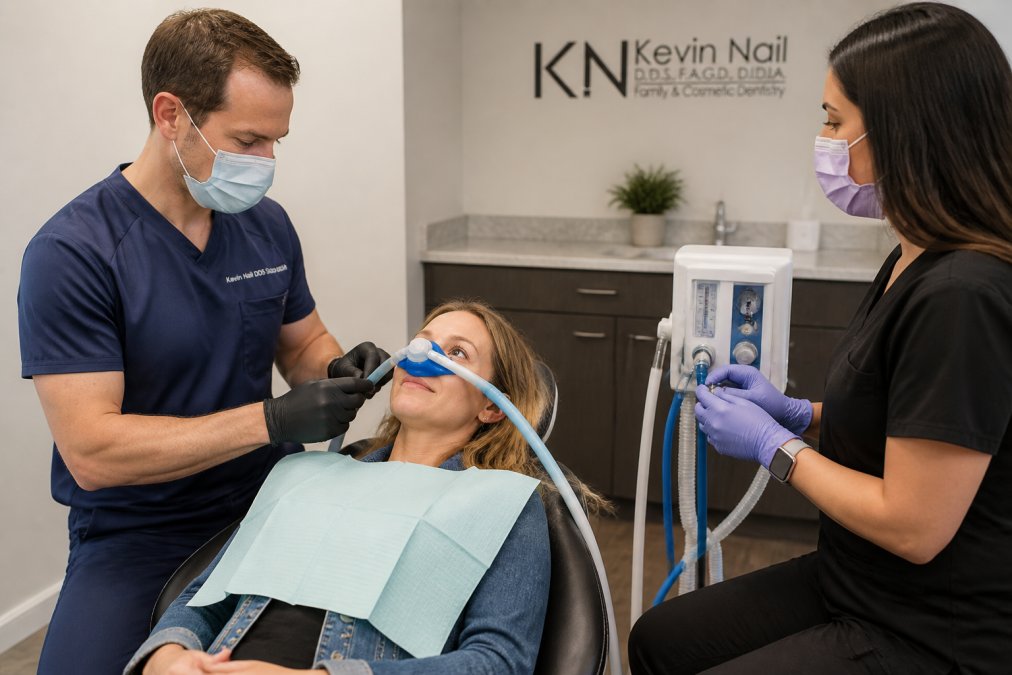
Here's how a sedation appointment typically runs:
- Pre-operative review. Your dentist confirms your health history, medications, and fasting status.
- Monitoring setup. Vital signs are recorded before sedation begins.
- Sedation administration. The method and dose are adjusted to your response.
- Treatment. The procedure is completed while your comfort level is monitored throughout.
- Recovery. You're observed until discharge criteria are met.
- Escort and post-operative care. You leave with a driver and written aftercare instructions.
Expect to arrange transportation home. Driving after moderate sedation is not an option, and most practices require an adult escort as a condition of treatment.
Is Sedation Dentistry Safe?
Sedation dentistry has a strong safety record when patients are properly screened and monitored, but it is not risk-free. Complications are rare and most often linked to undiagnosed health conditions, drug interactions, or inadequate monitoring.
What reduces risk:
- A thorough health history and medication review before treatment
- Appropriate fasting for the sedation level used
- Continuous monitoring of vital signs
- Trained staff and emergency equipment on site
- Clear post-operative instructions
Patients with sleep apnea, significant heart or lung conditions, or certain medication regimens need a more careful evaluation. Tell your dentist everything, including supplements and over-the-counter drugs. Withholding information is the single most common way patients increase their own risk.
At Kevin Nail DDS, Dr. Nail personally performs every procedure in our Copperfield practice, and our long-term team knows our patients by name. That continuity matters for sedation planning, because the person who reviews your health history is the same person treating you. If you're weighing sedation for an upcoming procedure, call 281-550-9054 to talk through your options.
The hardest part of sedation dentistry isn't the procedure. It's the estimate sitting in front of you with codes you don't recognize and a coverage answer that changes depending on who you ask. At Kevin Nail DDS, we handle family cleanings, cosmetic work, and minimally invasive implant placement under one roof, using 3D cone beam CT scans for precision and flapless techniques that reduce post-operative swelling and recovery time. Get started with Kevin Nail DDS and walk into your next appointment knowing exactly what's happening and what it costs.
Frequently Asked Questions
How much do dentists charge for sedation?
The cost of sedation dentistry varies based on the type of sedation used, the complexity of the procedure, and your location. Nitrous oxide is typically the most affordable option, while IV sedation costs more due to the additional monitoring required. Because pricing depends on these factors, we recommend contacting a local dental office directly for a personalized quote. Many practices also offer payment plans to help manage out-of-pocket expenses.
Will insurance cover sedation dentistry?
Insurance coverage for sedation dentistry depends on your specific plan and the reason for sedation. If the sedation is deemed medically necessary, such as for a patient with severe dental anxiety or a complex procedure, your insurance may cover a portion of the cost. However, for routine cleanings, it is often considered elective and not covered. Check with your insurance provider to understand your benefits and ask your dental office for help with billing codes.
What are the different levels of dental sedation available?
There are three main levels of sedation dentistry: nitrous oxide (laughing gas), oral sedation (pills), and IV sedation. Nitrous oxide provides mild relaxation and wears off quickly. Oral sedation offers moderate sedation and is taken before your appointment. IV sedation delivers the deepest level of conscious sedation, allowing for a relaxed state during complex procedures. Your dentist will recommend the appropriate level based on your anxiety and treatment needs.
How can I manage dental anxiety without breaking the bank?
Managing dental anxiety affordably starts with open communication with your dentist. Simple techniques like deep breathing, listening to music, and scheduling morning appointments can help. For more severe anxiety, nitrous oxide is a cost-effective sedation option. Additionally, ask about dental financing options or payment plans to spread out the cost of sedation.