 ultimate-guide
Family Dental Care in Copperfield: Your 2026 Guide
Table of Contents
- How to Choose a Dental Office in Houston for Your Whole Family
- Preventative Dental Care for Families: What Happens at Every Age
- Minimally Invasive Dental Procedures: Less Discomfort, Faster Recovery
- Cosmetic and Restorative Dentistry Under One Roof
- Sedation Dentistry and Managing Dental Anxiety
- Emergency Dental Care and Insurance Coverage Explained
- What to Look for in Family Dental Care in Copperfield
- Frequently Asked Questions
Last Updated: September 11, 2026
How to Choose a Dental Office in Houston for Your Whole Family
Family dental care in Copperfield works best when one provider handles every age and treatment stage under a single roof. At Kevin Nail DDS, we provide comprehensive care for all ages and treatment stages.
The convenience argument is obvious. The clinical argument is stronger. When one dentist tracks your family's history, small problems get caught before they become expensive ones. The American Dental Association's guidance on finding a dentist makes the same point: continuity of care improves outcomes because your provider sees patterns, not isolated visits.
Why a Single Provider Beats Juggling Three Dentists
A single provider eliminates the handoff problem. Records don't get lost between offices, medication lists stay current, and treatment planning accounts for the whole family's schedule and budget.
A common mistake: choosing a pediatric dentist for the kids and a separate practice for adults, then discovering the offices use different imaging systems and can't share files, so you repeat X-rays and re-explain medical history at every visit.
- One set of records for the entire household
- Consistent preventive philosophy across all ages
- Easier scheduling when appointments can be coordinated
- A team that recognizes your family by name, not chart number
Questions to Ask Before You Book
Ask these five questions before committing:
- Does the same dentist perform procedures, or will I see a rotating roster?
- What emergency hours are available, and how quickly can I be seen?
- Which insurance plans does the office accept, and does it file claims directly?
- What technology is used for imaging and diagnosis?
- How does the practice handle anxious patients or children who need extra time?
The answers reveal more than any website. A practice that hesitates on question one is telling you something.
Preventative Dental Care for Families: What Happens at Every Age
Preventative dental care for families changes as children grow: the routine stays constant, but risks shift from cavity prevention in childhood to gum health and restoration in adulthood.
Preventative dentistry protects oral health through regular exams, cleanings, and early intervention before disease develops. It's cheaper, faster, and less uncomfortable than treating problems after they start.
A comprehensive oral exam typically includes a visual inspection, periodontal health assessment, oral cancer screening, and digital imaging when needed. For children, the first visit should happen by their first birthday, according to the American Academy of Pediatric Dentistry's recommendations.
The 2-2-2 Rule and Other Habits That Actually Work
The 2-2-2 rule: brush twice a day for two minutes, and see a dentist twice a year. It's the most effective habit a family can build together.
What most guides miss: technique matters more than frequency. A child who brushes two minutes with poor angle and no flossing still develops cavities. Parents who brush alongside their kids, modeling the motion, see better results than those who simply remind them.
- Brush for two minutes, twice daily, with fluoride toothpaste
- Floss once daily, ideally before brushing
- Limit sugary drinks to mealtimes rather than sipping all day
- Replace toothbrushes every three to four months
- Schedule cleanings every six months unless your dentist recommends otherwise
Your First Visit: A Step-by-Step Walkthrough
Your first visit establishes a baseline:
- Intake and history review (10-15 minutes). Bring insurance information and a list of medications.
- Comprehensive oral exam. The dentist checks teeth, gums, bite, and soft tissue.
- Digital imaging. X-rays or 3D scans capture what the eye can't see.
- Cleaning. A hygienist removes plaque and tartar, then polishes.
- Treatment planning. You leave with a clear picture of what's needed and what can wait.
Expected result: a written plan, a cost estimate, and a scheduled follow-up if needed.
Minimally Invasive Dental Procedures: Less Discomfort, Faster Recovery
Minimally invasive dental procedures reduce trauma to surrounding tissue, less swelling, less bleeding, faster return to normal activity. That's a measurable difference in recovery, not marketing language.
The shift matters most for implants. Traditional placement lifts a flap of gum to expose bone; flapless techniques use 3D imaging to plan the exact angle and depth, then place the implant through a small opening. Patients often report far less post-operative discomfort and many return to work the next day.
Flapless Implants and 3D CBCT Scanning
3D cone beam CT (CBCT) scanning produces three-dimensional views of jawbone structure, nerve pathways, and sinus cavities, letting a dentist plan implant placement with sub-millimeter precision before any instrument touches the mouth.
That precision makes flapless placement possible. Without accurate 3D mapping, working through a small opening would be guesswork; with it, the dentist knows where bone is dense enough to support an implant and where nerves run.
Dr. Kevin Nail trained in this protocol and is a featured guest lecturer and trainer for the Academy of Minimally Invasive Implant Dentistry. He is currently the first and only accredited AMII protocol trained dentist in Texas.
Cosmetic and Restorative Dentistry Under One Roof
Cosmetic and restorative work overlap more than most people realize: a crown restores function and appearance, bonding repairs a chip, veneers reshape front teeth. When one practice handles all of it, the result looks consistent rather than piecemeal.
Porcelain veneers are thin, custom-made shells bonded to the front surface of teeth to change their color, shape, or alignment. Dental bonding applies a tooth-colored composite resin to repair chips, close gaps, or build up worn edges. Teeth whitening lifts staining from the enamel surface.
The most common worry is that cosmetic work will look artificial. The answer is shade matching and proportion: a good dentist matches veneers to your natural enamel and shapes them to fit your face, not a template.
| Treatment | Best For | Typical Visits | Reversible? |
|---|---|---|---|
| Dental bonding | Chips, small gaps, minor reshaping | 1 | Yes |
| Porcelain veneers | Discoloration, shape, alignment | 2-3 | No |
| Teeth whitening | Surface staining | 1-2 | Yes |
| Dental crowns | Cracked or heavily restored teeth | 2 | No |
| Full-mouth restoration | Multiple damaged teeth | Varies | No |
Sedation Dentistry and Managing Dental Anxiety
Sedation dentistry uses medication to reduce anxiety and discomfort during treatment. It's not reserved for complex procedures. Many patients use it for routine cleanings because the anxiety itself is the barrier.
The safety question deserves a direct answer. Sedation is administered at levels matched to the patient and procedure, with continuous monitoring, and a dentist trained in sedation protocols evaluates your health history, medications, and airway first (the American Dental Association). Levels range from mild (relaxed, awake, responsive) to moderate (drowsier, reduced memory) to deeper sedation for longer cases, the right level depends on the patient, not the procedure alone.
Preparing a Child for Their First Dental Visit
The first visit can set the tone for future dental care. A child who has a negative experience may carry that fear into adulthood, potentially leading to avoidance of dental care.
A first visit for a young child can focus on familiarization: sitting in the chair, meeting the dentist, counting teeth, and touching a mirror.
A few things that reliably work:
- Schedule for the child's best hour. Morning appointments suit most young children. A tired or hungry child is a harder patient than a nervous one.
- Use neutral language at home. Avoid words like "pain," "shot," "drill," or "pull." Say "the dentist will count your teeth" instead of "it won't hurt." The reassurance plants the idea that hurting was a possibility.
- Let the child bring a comfort object. A stuffed animal or blanket in the chair is not a distraction. It's a tool.
- Model the visit. A parent who sits in the chair first and opens wide shows the child there's nothing to fear. Children copy what they see far more than what they're told.
- Keep the first visit short. Fifteen to twenty minutes is plenty. End on a positive note before attention runs out.
Tell-show-do is the technique most pediatric-trained dentists rely on: explain each instrument in child-friendly terms, demonstrate it on a finger or model, then use it. Nothing happens without warning, and that predictability converts fear into cooperation.
When Sedation Is the Right Call for a Child
Sedation for children isn't a shortcut for an uncooperative kid. It's a clinical decision for specific situations: a very young child with several cavities, a procedure too long to tolerate awake, a strong gag reflex, or anxiety severe enough that an awake visit would be traumatic.
The dentist evaluates the child's health history, weight, airway, and the procedure before recommending any sedation level. Parents should expect a full conversation, not a form to sign, a practice that offers sedation without one is a reason to look elsewhere.
What Parents Should Ask Before Any Sedation
- Who administers the sedation, and what is their training?
- What monitoring is used during the procedure?
- What level is being recommended, and why that level rather than a lighter one?
- What are the instructions for the hours before and after?
- What is the plan if the child has an unexpected reaction?
A practice that answers these clearly and without defensiveness has thought about them. That's the standard to hold any office to, for a child or an adult.
Emergency Dental Care and Insurance Coverage Explained
Emergency dental services address sudden pain, swelling, broken teeth, or knocked-out teeth. The first step is always the same: call the office. Some problems can wait a day. Others, like a knocked-out permanent tooth, need care within the hour.
A few situations that count as true emergencies rather than next-day problems:
- A knocked-out permanent tooth. Handle it by the crown, not the root. If you can, rinse it gently and place it back in the socket. If not, keep it in milk or saliva and get to a dentist within the hour. Time is the variable that decides whether the tooth survives.
- Uncontrolled bleeding from the mouth that doesn't stop with firm pressure.
- Swelling that affects your eye, your throat, or your ability to swallow or breathe. This is a medical emergency. Call 911 or go to an emergency room, not a dental office.
- Severe pain that keeps you awake or doesn't respond to over-the-counter pain relievers.
- A broken or cracked tooth with a sharp edge that's cutting your tongue or cheek.
For anything else, a same-day or next-day call is usually the right move. A chipped tooth with no pain can typically wait until the office opens.
PPO vs. HMO: What the Difference Actually Means for Your Family
Most dental insurance falls into two structures, and the difference matters more than the brand name on the card.
A PPO (Preferred Provider Organization) lets you see any dentist, in-network or out-of-network. In-network dentists accept negotiated rates, so your out-of-pocket cost is lower. Out-of-network dentists may charge more, and the plan reimburses a set percentage of its usual and customary fee, you can still see the dentist you want, but you'll pay more.
An HMO (Health Maintenance Organization), sometimes called a DHMO, works differently: you choose a primary dentist from the network, who provides care at set copays. There's usually no annual maximum or deductible, but the trade-off is a smaller network and no out-of-network care except in an emergency. If your dentist leaves the network, you switch.
A quick way to think about it:
- PPO: more flexibility, higher premiums, percentage-based coverage, annual maximums.
- HMO: lower premiums, fixed copays, less flexibility, smaller network.
Neither is universally better. A family that values seeing one specific dentist for everyone should lean PPO. A family that wants predictable costs and is willing to work within a network may find an HMO works fine.
The Questions That Actually Reveal Your Coverage
Most people ask "is this covered?" and get a yes-or-no answer that turns out to be wrong. The real answer is almost always a percentage, and it depends on where you are in your plan year. Ask these instead:
- What percentage does my plan cover for this procedure, and which tier does it fall into (preventive, basic, or major)?
- Have I met my deductible this year, and how much is left?
- Is there an annual maximum, and how much of it remains?
- Is this dentist in-network, and if not, what will I owe out-of-network?
- Does the plan require pre-authorization for this procedure?
That last one catches people off guard. Crowns, bridges, and implants often require the plan to approve treatment beforehand; skipping that step can mean paying the full cost out of pocket and fighting for reimbursement later.
If You Don't Have Insurance
Ask about payment options directly. Practices vary widely, and pricing depends on the treatment plan rather than a flat menu. Common arrangements include in-house membership plans bundling cleanings, exams, and X-rays for an annual fee, third-party financing for larger treatment, and phased plans that spread work across visits and budget cycles.
Kevin Nail DDS can walk through costs and scheduling at 281-550-9054.
What to Look for in Family Dental Care in Copperfield
The right practice is one where the same dentist treats your children, your spouse, and you, and the staff remembers your name without checking a screen. That sounds simple; it's rarer than it should be.
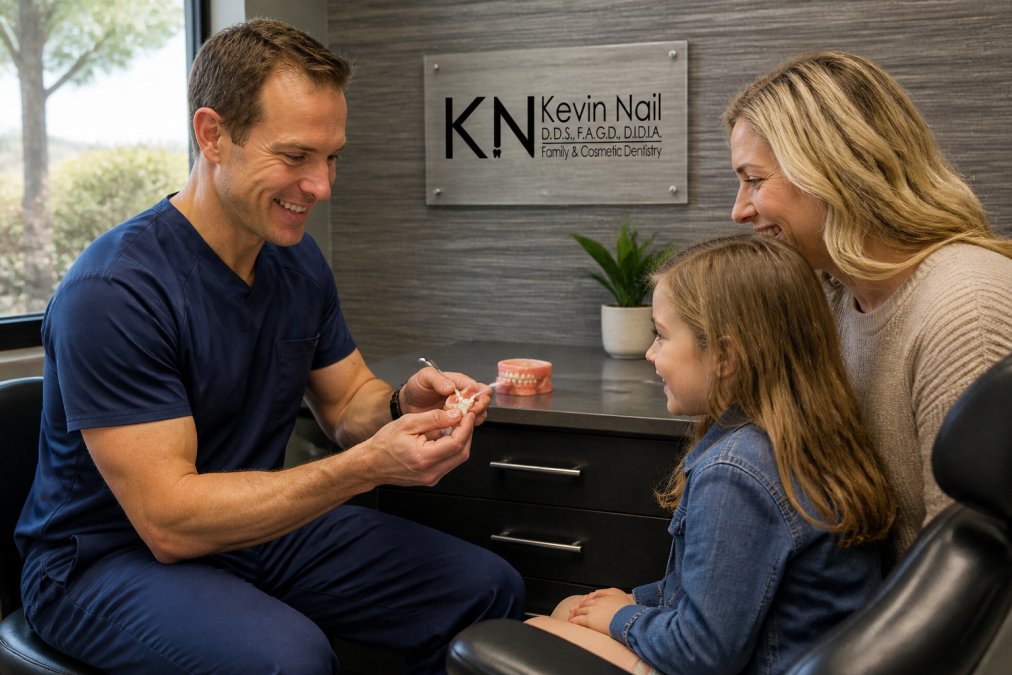
Look for a privately owned practice where the doctor performs procedures personally rather than delegating, advanced imaging (diagnosis quality depends on it), long-term staff (turnover breaks continuity), and honest treatment planning where the dentist tells you what can wait.
Kevin Nail DDS is a privately owned practice in Copperfield where Dr. Nail personally performs every procedure. His credentials include Fellowship in the Academy of General Dentistry, Diplomate status with the International Dental Implant Association, and recognition as the 2013 USAF Materiel Command Clinical Dentist of the Year. The practice also serves as the official dental partner for Prodigy Baseball.
Finding a practice that treats a four-year-old and a forty-year-old with the same care is harder than it should be, and switching providers mid-treatment creates real problems. Kevin Nail DDS handles preventative care, cosmetic work, sedation, and minimally invasive implants under one roof, with the same dentist performing every procedure and a team that knows patients by name. If you're tired of juggling appointments across three offices, call 281-550-9054 and schedule a visit for the whole family.
Frequently Asked Questions
What services should a comprehensive family dental practice provide?
A comprehensive practice handles preventative checkups, cleanings, fillings, crowns, root canal therapy, gum disease treatment, cosmetic work like porcelain veneers and teeth whitening, and restorative options including dental implants. Having all services under one roof means your whole family sees providers who already know your history. It also cuts down on referrals and repeat X-rays. When touring a practice, ask whether they treat children and adults, and whether complex procedures stay in-house.
How often should children visit a family dentist?
Most children benefit from a checkup every six months, starting around their first birthday or within six months of the first tooth appearing. Kids with a higher risk of cavities may need more frequent visits. Routine checkups let the dentist catch decay early, apply sealants if needed, and track jaw development. Consistency matters more than the exact interval, so pick a schedule your family can keep and stick with it.
What are the benefits of choosing a privately owned dental practice?
In a privately owned practice, the dentist often performs every procedure personally, so you are not passed between rotating providers. You tend to see the same faces at each visit, which helps with anxious patients and children. Decisions about treatment planning stay with the dentist rather than a corporate protocol. If personalized care and a long-term relationship matter to you, ask how the practice is structured before you book.
How much does a family dentist cost, and will my PPO insurance cover it?
Costs vary widely by procedure, location, and your plan. Preventative visits like routine checkups and cleanings are often covered at a high percentage by PPO insurance, while cosmetic work such as porcelain veneers is typically not covered. Restorative procedures like dental crowns or implants may be partially covered depending on your plan's annual maximum. Ask the front office to run a benefits check before treatment so you know your out-of-pocket estimate in advance.