 How-to
How to Maintain Dental Implants: A Daily Care Guide
Last Updated: November 13, 2026
Quick Summary
To maintain dental implants for longevity, brush twice daily with a soft-bristled brush and low-abrasion fluoride toothpaste, and clean between every implant and adjacent tooth once daily. Implants don't decay, but the gums and bone around them can fail, so daily care plus professional visits protects the bone, not the titanium.
- Brush for two full minutes, morning and night, angling bristles toward the gumline.
- Clean between every implant and adjacent tooth once daily with an interdental brush or implant-safe floss.
- Rinse with water after every meal to clear loose food before it settles at the implant collar.
- Inspect your restoration once a week for looseness, chips, or new food traps.
- Call your dentist within a day or two if you notice pus, a loose restoration, or spreading swelling.
Table of Contents
- How to Clean Dental Implants at Home
- Dental Implant Cleaning Tools That Protect Your Investment
- How to Care for Full Mouth Dental Implants
- A Daily and Professional Maintenance Schedule for Implant Longevity
- Warning Signs of Implant Problems and When to Seek Care
- Dental Implant Maintenance Cost: What to Expect
- Schedule Your Implant Maintenance Visit
- Frequently Asked Questions
How to Clean Dental Implants at Home
Learning how to maintain dental implants for longevity starts with one truth: implants don't decay, but the gums and bone around them can fail. Your daily routine protects the bone, not the titanium.
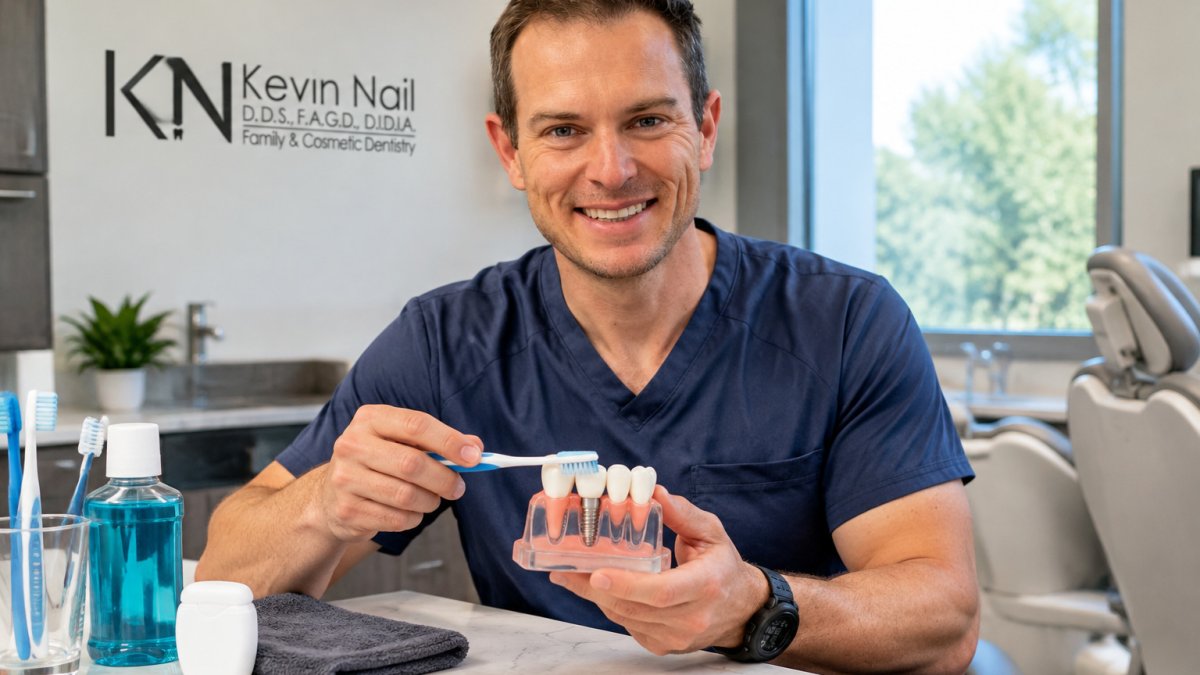
Dental implant maintenance is the daily and professional care that keeps the gums and bone around an implant healthy so the restoration lasts. It combines brushing, interdental cleaning, and routine dental visits. Alongside brushing and interdental cleaning, learning how to clean around a dental implant helps keep the surrounding gums healthy between routine dental visits.
Skip that care, and plaque builds up along the implant collar. Gum inflammation follows. Left alone, it can progress to bone loss.
Brushing Around Implant Crowns and Bridges
Brush twice a day with a soft-bristled toothbrush and fluoride toothpaste (the American Dental Association). Angle the bristles toward the gumline, where the crown meets the implant.
Use gentle, circular strokes. Abrasive pressure can irritate the gum tissue around an implant-supported crown.
- Brush for two full minutes, morning and night
- Use a low-abrasion fluoride toothpaste
- Replace your brush every three months
- Pay extra attention to the back of the mouth
Interdental Cleaning and Flossing
Clean between the implant and neighboring teeth once daily. This is where plaque hides and where most problems begin.
An interdental brush works well for implant-supported bridges. For single crowns, use implant-safe floss or soft picks.
- Clean between every implant and adjacent tooth
- Use gentle in-and-out motions, not snapping
- Rinse the tool after each gap
- Ask us which tool fits your restoration
Dental Implant Cleaning Tools That Protect Your Investment
The right dental implant cleaning tools make daily care easier and safer. The wrong ones can scratch the crown surface or irritate gum tissue.
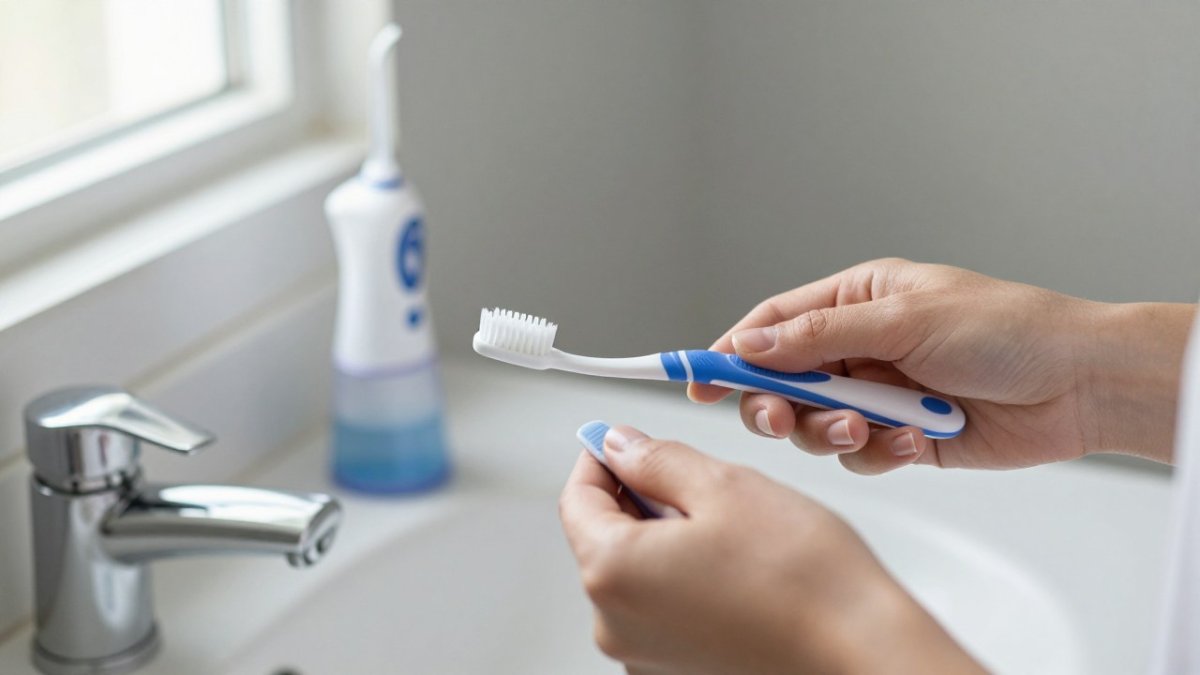
Common home-care tools include:
- Soft-bristled toothbrush: the default for all implant patients
- Interdental brushes: best for bridges and wide gaps
- Water flosser: useful for full-arch restorations and hard-to-reach areas
- Fluoride toothpaste: low-abrasion formulas protect crowns
- Antimicrobial mouth rinse: an add-on, not a replacement for brushing
Stiff bristles can irritate gum tissue.
How to Care for Full Mouth Dental Implants
Full-arch restorations need a different routine than single implants. Food collects under the prosthesis, and you often can't see it.
Clean under the restoration every day. A water flosser reaches areas a brush can't.
- Rinse with water after every meal
- Use a water flosser on a low setting along the gumline
- Clean the abutments with an interdental brush
- Remove and clean any removable prosthesis as directed
Watch out: skipping the area under a full-arch restoration lets plaque sit against the implant collars for hours. That is exactly where peri-implant inflammation starts.
A Daily and Professional Maintenance Schedule for Implant Longevity
A clear schedule beats good intentions, but there is no single schedule that fits every implant patient. The daily tasks are similar for most people. The professional interval is not. Recall intervals are generally individualized based on risk factors, restoration type, and gum disease history.
Daily Tasks
| When | What to Do | Why It Matters |
|---|---|---|
| After every meal | Rinse with water | Clears loose food before it settles at the implant collar |
| Twice daily | Brush two minutes with a soft brush and low-abrasion fluoride toothpaste | Removes plaque at the gumline |
| Once daily | Clean between every implant and adjacent tooth | Protects the tissue where most problems start |
| Once daily | Use a water flosser if recommended for your restoration | Reaches under bridges and full-arch prostheses |
Weekly and Ongoing Tasks
- Inspect your restoration once a week for looseness, chips, or food traps you didn't notice before
- Replace your brush head every three months, or sooner if bristles splay
- Check your interdental brush size at each hygiene visit, gum changes can change the fit
- Review your rinse use with your dentist; antimicrobial rinses are an add-on, not a substitute for mechanical cleaning
Professional Intervals Are Individualized
Recall intervals are a starting point rather than a fixed rule. Some patients with the following risk factors may be placed on a shorter recall:
- A history of periodontitis before implants
- Smoking or other tobacco use
- Poorly controlled diabetes
- Peri-implant mucositis that has needed treatment before
- Full-arch or overdenture restorations that are harder to clean at home
- Bruxism or a history of component loosening
Patients with a single implant, healthy gums, no risk factors, and a stable restoration may do well on a standard six-month schedule. Ask your dentist what interval your specific risk profile supports, and revisit that answer if your health changes.
What Professional Maintenance Should Include
A maintenance visit for an implant patient is not the same as a routine cleaning for natural teeth. It should include probing around the implant, assessment of the gum tissue, a check of restoration stability and bite, and cleaning with instruments that won't scratch the implant surface. If your hygienist doesn't ask about your home routine or check the restoration for looseness, say something.
Watch out: skipping professional visits because your implant "feels fine" is the most common way patients miss early bone loss. Implants rarely hurt until the problem is advanced.
If you want to protect the rest of your smile too, read our guide on maintaining your smile makeover results.
Warning Signs of Implant Problems and When to Seek Care
Most implant problems announce themselves before they become expensive. The trouble is that the early signals are easy to dismiss because they don't hurt. Knowing which symptom means "call today" and which means "mention it at your next visit" is the difference between a reversible fix and bone loss.
The Two Conditions Behind Almost Every Failing Implant
Peri-implant mucositis is inflammation confined to the soft tissue around the implant (pubmed.ncbi.nlm.nih.gov). The gums may bleed when you brush, look red, or feel tender, but the bone is intact. Mucositis is reversible with professional cleaning and improved home care.
Peri-implantitis is the same inflammation plus progressive bone loss around the implant (pubmed.ncbi.nlm.nih.gov). Once bone is gone, it does not grow back on its own. A common pattern in practice is that mucositis precedes peri-implantitis, which is why bleeding that persists for more than a week or two deserves a professional look rather than a wait-and-see approach.
Symptoms That Warrant Prompt Evaluation
Call your dentist within a day or two if you notice any of the following:
- Pus or a bad taste near the implant, this suggests active infection, not routine irritation
- A loose crown, bridge, or overdenture, a wobbly restoration can mean a loose abutment screw or a failing implant connection
- Pain when chewing or biting that wasn't there before
- Swelling that spreads beyond the gumline or comes with fever
- A change in your bite, your teeth suddenly meeting differently can signal a shifting restoration or component failure
- Visible gum recession exposing the implant collar or threads
These are the signs that most practitioners treat as urgent. Waiting for a scheduled cleaning can let an infection spread into bone.
Symptoms to Track and Report at Your Next Visit
Some findings are worth noting but rarely require same-day care:
- Bleeding only when you brush, with no swelling or pain
- Mild redness along the gumline that improves with better hygiene
- Food trapping in a new spot around a bridge or overdenture
- A dull ache that appears only with heavy chewing
Write these down with dates. A pattern of recurring bleeding at one implant site tells your hygienist more than a single observation.
Watch out: bleeding that persists for more than two weeks despite good home care is not normal, even if it doesn't hurt. Persistent bleeding is the most common early sign patients overlook.
Risk Factors That Change Your Threshold
Some patients should call sooner rather than later. Smoking and other tobacco use can affect blood flow to the gums and increase the risk of implant complications. Uncontrolled diabetes slows healing and raises infection risk. A history of severe gum disease before implants means your surrounding tissue is more vulnerable. Bruxism, or clenching and grinding, adds bite force that can loosen components or fracture crowns.
If you have one or more of these risk factors, treat any new symptom as worth a phone call. Your dentist may want to shorten your recall interval rather than wait for the next six-month visit.
If something feels wrong, don't wait for your next cleaning. Our guide on choosing the right dental implant specialist explains what to look for in the clinician who evaluates it.
Dental Implant Maintenance Cost: What to Expect
Pricing for maintenance visits depends on your needs and your plan. Contact our office for current prices or a quote.
Exact pricing depends on your needs and your plan. We can't quote a number without an exam. For real-world expectations, see our breakdowns of dental implant cost with PPO coverage and dental implant cost with insurance.
Insurance questions come up a lot. Coverage for implant-specific maintenance varies by plan, so check with your insurer.
Ask three questions before you budget:
- Does my plan cover periodontal maintenance?
- Is there an annual maximum I should track?
- What is my out-of-pocket cost for a deep cleaning?
Schedule Your Implant Maintenance Visit
Consistency is what separates implants that last decades from ones that fail early. Your daily routine handles most of the work. Professional visits catch what you can't see.
At Kevin Nail DDS, Dr. Nail personally performs every procedure, including minimally invasive implant care. Our team includes long-term staff, and same-day emergency care is available.
You can review our implant and restorative services on our implant dentistry services page.
Protecting an implant takes a few minutes a day and a visit twice a year. If you're due for a checkup or something feels off, don't put it off. Get started with Kevin Nail DDS and keep your implant working for years to come.
Frequently Asked Questions
What is the average lifespan of dental implants?
With proper care, dental implants can last 20 years or more, and many last a lifetime. Longevity depends on daily oral hygiene, regular professional maintenance visits, and controlling risk factors like smoking or teeth grinding. Implant-supported crowns may need replacement after 10 to 15 years of wear, but the implant itself often remains stable. Following a consistent home care routine and attending recall appointments are the most reliable ways to protect your investment.
Is it hard to keep dental implants clean?
Cleaning dental implants is similar to caring for natural teeth, though it requires extra attention around the gumline and prosthetic components. A soft-bristled toothbrush, fluoride toothpaste, interdental brushes, and a water flosser handle most daily cleaning. The main difference is that implants lack a periodontal ligament, so plaque buildup near the gumline can progress without the early warning signs natural teeth provide. Regular checkups help catch issues before they become serious.
How often should you have dental implant maintenance visits?
Most patients benefit from professional implant maintenance every six months, though your dentist may recommend three- to four-month intervals if you have a history of gum disease, smoke, or have full-arch restorations. These visits include a dental examination, professional cleaning around the implant and prosthetic components, and checking bite pressure. Your recall interval should be personalized based on your risk factors and home care habits.
What tools are best for cleaning around dental implants?
A soft-bristled toothbrush and fluoride toothpaste form the foundation of daily cleaning. Interdental brushes sized to fit the spaces around your implant crowns remove plaque between teeth and under bridgework. A water flosser helps flush bacteria from hard-to-reach areas, especially around full-arch restorations. Your dentist may also recommend a night guard if you grind your teeth to protect both the implant and the restoration from excess bite pressure.